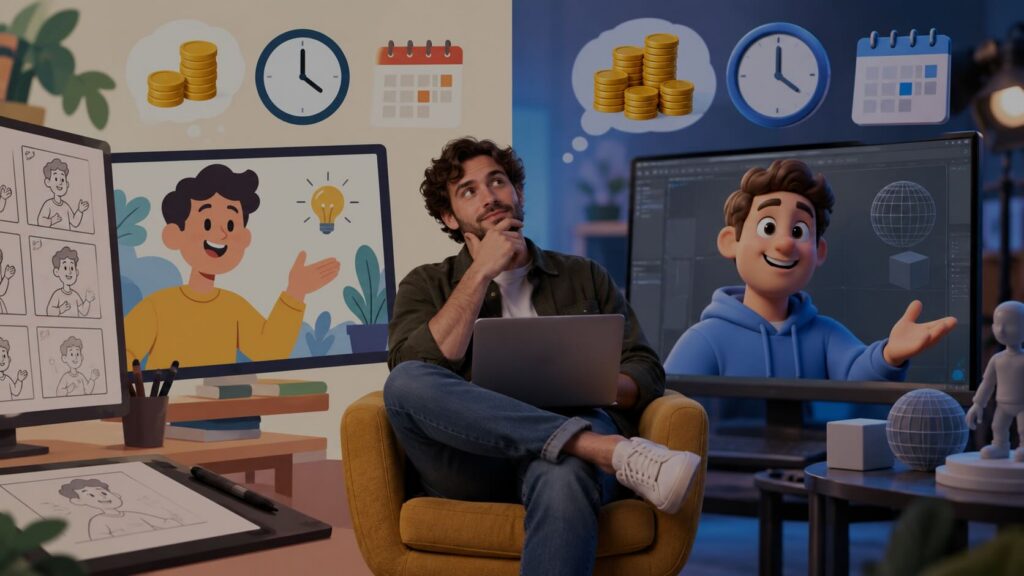

Quick answer: AI video ads are commercials made with AI-generated visuals (cinematic scenes, animated characters or digital presenters) instead of a camera crew. At Gisteo, AI avatar ads start at $1,000 and cinematic AI commercials at $3,500. The AI is the fast part: a finished ad still needs a clear concept, a script, editing, sound and a reason to act.
Introduction
For most of advertising history, video ads were a game only well-funded brands could play at the highest level. A 30-second commercial with cinematic quality meant hiring a director, booking a crew, sourcing locations, casting talent, and enduring weeks of post-production — easily $50,000 to six figures before the first impression was served.
AI video ads are changing that equation in ways that are now measurable, not just theoretical.
Gisteo recently produced a 30-second AI video ad for an Atlanta-based luxury car rental brand. No actors. No cameras. No crew. No location shoots. The result was a cinematic commercial with a premium look and feel that is now running on Netflix’s advertising platform in the Greater Atlanta area. The cost was a fraction of what traditional production would have required.
That’s not an outlier or a proof-of-concept experiment. It’s where AI video advertising is in 2026 — and this guide covers what that means for brands that want to produce high-quality video ads without the traditional production overhead.
We’ll cover what AI video ads actually are, how they’re produced, where they perform well, what they still can’t do on their own, and how to find the right partner to produce them.
What Are AI Video Ads?
AI video ads are advertising videos produced using artificial intelligence tools to generate some or all of the visual content — rather than filming with cameras, crews, and physical locations.
That definition covers a wide spectrum. On one end, you have simple tools that animate a static image or add motion to a product photo. On the other end — and this is where the most significant shift has happened — you have generative AI systems capable of producing photorealistic footage: characters who move naturally, environments with depth and atmosphere, dynamic camera work, and cinematic lighting that rivals what a production crew could capture on location.
The most relevant formats for advertising in 2026:
- Cinematic AI ads: Fully AI-generated video content that produces brand films, commercials, and awareness ads with movie-quality aesthetics. Characters, environments, and camera movement are all generated — not filmed. Best for brand storytelling, emotional impact, and premium positioning.
- AI avatar ads: Videos featuring lifelike digital presenters — AI-generated human faces and voices that deliver scripted content directly to camera. Best for product explanations, direct-response ads, spokesperson content, and multilingual campaigns where consistent delivery across markets is needed.
- AI-enhanced hybrid ads: Productions that combine AI-generated elements with real footage, motion graphics, or traditional animation. This approach can supplement existing brand assets, extend a campaign at lower cost, or produce visual sequences that would be impractical to film.
The choice between these formats isn’t aesthetic preference — it’s a strategic decision based on the ad’s goal, the audience, the platform, and the brand’s existing visual identity.
Animated AI Video Ads vs. Other AI Ad Formats
Animated AI video ads are advertisements that use artificial intelligence to help create illustrated characters, moving images, environments or other visual elements. They may combine generated footage with custom animation, real product assets, on-screen text and voiceover.
The terminology gets messy because people use “AI animation” to describe several different things. A cartoon character, a realistic generated scene and a digital presenter can all show up in the same search results. They require different production decisions.
| Approach | What the viewer sees | A useful application |
|---|---|---|
| AI-generated character animation | Illustrated or stylized characters in generated scenes | A short story, humorous situation or visual metaphor |
| Cinematic AI video | Realistic-looking people, places and action | A commercial built around a situation or emotion |
| Custom motion graphics | Deliberately animated text, diagrams, shapes and interfaces | Explaining a process, product or abstract service |
| AI avatar video | A digital presenter delivering a script | A straightforward offer, explanation or announcement |
| Hybrid production | Generated scenes combined with controlled graphics and real assets | An ad that needs creative freedom and accurate product details |
Custom motion graphics can be produced with or without AI assistance. An animated video does not become an AI video simply because it was made on a computer.
For a buyer, the important distinction is how much control the project needs. A whimsical scene can allow room for interpretation. A product demonstration may need to show precisely what happens when someone presses a button.
Why AI Video Ads Are a Meaningful Shift
The obvious appeal of AI video ads is cost. Traditional production is expensive, and AI lowers the production cost significantly. But framing this purely as a cost story undersells what actually changes.
More creative concepts can be tested before committing
Traditional production forces an early and costly commitment to a single creative direction. Because a crew shoot is expensive and largely irreversible once booked, most brands produce one ad, hope it works, and iterate slowly based on performance data.
AI production is fundamentally different. Producing multiple versions of an ad concept — different opening hooks, different emotional tones, different calls to action — costs a fraction of what traditional production would. Brands can test concepts against real audience data and scale what performs, rather than betting everything on a single creative direction.
High production quality is no longer a budget threshold
Premium visual quality used to be a meaningful differentiator for large brands because smaller competitors couldn’t afford to match it. AI has lowered that floor. A brand with a modest production budget can now produce a commercial with cinematic quality that would have required a significant agency retainer five years ago.
This doesn’t mean every AI ad looks great — creative direction and production expertise still determine quality. But the budget required to produce something that looks genuinely good is substantially lower than it was.
Campaign volume and velocity become achievable
The social and streaming advertising landscape rewards volume. Platforms want fresh creative. Audiences develop ad fatigue. The brands winning on paid social are often the ones who can produce content fast enough to stay ahead of creative burnout — testing new hooks, refreshing visuals, and adapting messaging to seasonal moments.
Traditional production can’t support that cadence at sustainable cost. AI production can. The economics of producing 10 ad variants rather than 1 change the entire campaign strategy.
Geographic and language expansion gets easier
Producing localized ad content for different markets used to mean separate production shoots or expensive dubbing workflows. AI avatar ads in particular make multilingual versioning fast and affordable — the same digital presenter can deliver a script in a dozen languages, with voiceover and lip-sync generated automatically. For brands targeting multiple regions, this isn’t a minor convenience. It’s a structural shift in what’s cost-effective to produce.
Where AI Video Ads Perform Best
AI video ads aren’t equally suited to every advertising context. Here’s a practical breakdown of where they tend to deliver the most value:
| Platform / Format | AI Ad Suitability | Why It Works |
| Connected TV (CTV) / Streaming | High | Cinematic AI quality holds up on large screens; no audience expectation of live-action |
| Paid social (Meta, TikTok, YouTube) | High | Fast iteration, multiple variants, high content volume — all AI strengths |
| Pre-roll and mid-roll video ads | High | Short formats (15–30s) play to AI’s production strengths |
| Display and banner (animated) | High | Motion graphics and AI-enhanced elements work well |
| OOH / digital signage | High | Looping visual content with no audio requirement |
| Brand awareness campaigns | High | Emotional storytelling, cinematic quality, no product complexity |
| Direct-response (click-to-buy) | Medium-High | Works well with avatar format; hook and CTA need sharp creative direction |
| Highly regulated industries (pharma, finance) | Medium | Compliance review adds friction; consult legal before finalizing visuals |
| Testimonial / user-generated style | Lower | Authenticity expectations can be harder to meet with AI-generated talent |
The sweet spot for AI video ads right now is brand awareness, product storytelling, and content that lives on streaming or paid social platforms — where production quality matters, iteration speed is an advantage, and there’s no requirement for “real people” authenticity.
The AI Video Ad Production Process
One of the most common misconceptions about AI video ads is that they’re produced by typing a prompt into a tool and downloading a finished commercial. That’s not how quality AI ad production works — and it’s why the gap between AI-generated content that looks generic and AI-generated content that looks genuinely great is almost entirely a function of creative direction.
A professional AI video ad production process typically moves through these stages:
1. Strategy and brief development
Defining the ad’s goal (awareness, consideration, conversion), the target audience, the platform, the desired emotional register, and the single most important message. This is human work. The quality of everything downstream depends on the clarity of the brief.
2. Concept development
Developing the creative direction — the story, the visual world, the tone, the hook, the pacing. For AI production, this also means thinking through what the AI tools can actually produce well, and designing the concept around those capabilities rather than fighting against their limitations.
3. Scriptwriting
Writing and refining the script, including voiceover copy and any on-screen text. AI tools can assist with drafts and variations, but the final script needs human judgment — especially the first five seconds, which determine whether viewers stay or skip.
4. Visual prompting and generation
Translating the approved concept into AI-generated footage through detailed, iterative prompting. This is where the craft of AI production lives. Generating a single usable scene often requires dozens of iterations — adjusting composition, lighting, character positioning, motion, and mood. An experienced AI director knows what to ask for and how to get it.
5. Assembly and post-production
Editing generated footage into a cohesive narrative, adding music, sound design, motion graphics, captions, and final color treatment. Even in AI productions, post-production shapes the final quality significantly.
6. Voiceover and audio
For most AI video ads, synthetic voiceover is now fully viable. Current AI voice tools produce natural, expressive audio that holds up in advertising contexts. Human voice talent remains the right choice when brand voice authenticity is a specific priority.
7. Platform optimization and versioning
Adapting the final ad for different platforms, aspect ratios, and lengths — and producing any variant creative (different hooks, different CTAs, silent versions) planned from the start.
From approved brief to final delivery, a well-run AI video ad production can move significantly faster than traditional production — often in days to weeks rather than months.
What AI Video Ads Still Require: The Human Element
AI production capability is real and improving fast. But the brands that produce mediocre AI ads and the ones that produce great ones are separated almost entirely by the human expertise brought to the process — not the tools used.
Here’s what AI doesn’t replace in video advertising:
- Advertising strategy. Understanding what the ad is for, who it’s reaching, where in the funnel they are, and what they need to feel or believe to take the next step — this is strategic work that determines whether the ad performs, not which AI tool generated it.
- Creative concept and story. The idea that makes an ad memorable, shareable, or emotionally resonant is a human invention. AI can produce high-quality footage to serve a great concept. It can’t originate the concept.
- The hook. The first three to five seconds of a video ad determine whether someone watches or skips. Writing a hook that stops the scroll — that says something surprising, provocative, or immediately relevant to the audience — is craft. It’s the highest-leverage second of the entire production.
- Brand alignment judgment. Knowing whether a generated scene fits the brand’s visual identity, tone, and positioning requires experience and taste. AI generates options. A human decides which ones are right.
- Quality control. AI-generated footage has characteristic failure modes — visual inconsistencies, unnatural motion in hands or faces, lighting that shifts between cuts, character continuity issues. Catching these and iterating past them requires a trained eye.
- Media strategy. How the ad is targeted, where it runs, how performance is measured, and how it feeds back into creative iteration — this is the layer that determines whether great creative actually reaches the right people.
The honest framing: AI video ad production is a collaboration between generative tools and human expertise. The ratio shifts toward AI on execution and toward humans on strategy, concept, and judgment. Both sides of that collaboration need to be strong.
AI Video Ads in Practice
The production model that’s proving most effective with AI video ads isn’t “produce one polished ad” — it’s “develop a campaign architecture and populate it efficiently.”
Here’s what that looks like in practice:
- Concept first, variants second. Start with a clear brand story and a primary 30-second ad. Then identify the two or three creative variables worth testing — different opening hooks, different emotional angles, different CTAs — and produce variants around the primary concept rather than from scratch.
- Platform-native cuts from day one. Rather than producing one ad and cropping it for other platforms, plan for vertical, square, and widescreen formats at the brief stage. AI production makes this much less expensive than traditional re-shoots.
- Performance-informed iteration. Run variants against real audiences, identify what’s working at the hook and CTA level, and refine the next round based on data. The low cost of AI production makes genuine creative testing economics work for brands that couldn’t afford it before.
- Evergreen plus seasonal. Produce a core brand asset designed for long-term use, plus lighter seasonal or promotional variants that refresh the campaign without rebuilding from scratch.
This is the model Gisteo used for 62or70.com — a Social Security claiming analysis tool with a complex, emotional message to communicate. Rather than one expensive commercial, we built a campaign with multiple AI video ads exploring different creative angles, allowing the brand to test messaging against their audience, identify what resonated, and scale accordingly. The total cost was a fraction of what a single traditional commercial would have run.
Examples of AI Video Ads From Gisteo
AI advertising can take several forms. These published Gisteo examples show the range beyond cartoon animation. Each is available through our AI video portfolio.
Luxury Exotic Rentals
Gisteo created a 30-second cinematic AI commercial for an Atlanta luxury car rental service without a conventional shoot. It illustrates how generated scenes can support a premium visual treatment.
The 62or70 campaign
For 62or70.com, a Social Security claiming analysis tool, Gisteo produced a series of AI campaign videos. The campaign offers an example of developing several creative treatments around one service.
EstateHub
Gisteo’s gallery includes several EstateHub videos, including “The One Person…” and “Two Outcomes.” The collection is another reference for businesses considering a series of short videos.
When you review these or any studio’s work, ask a practical question: can I imagine a similarly clear treatment of my own offer?
Also review the custom animation portfolio. Comparing the formats can help you decide how much visual flexibility, precision and future editability your project needs.
AI Video Ads vs. Traditional Production: Cost, Quality and Speed
Short answer: traditional production (a film shoot or fully hand-built animation) still wins for flagship brand spots that need exact control. AI video ads win when you need speed, many variations and a lower cost per ad. Most brands now use both: a traditional or custom-animated hero piece, plus AI-produced variations for testing and personalization.
| AI video ads | Traditional production | |
|---|---|---|
| Cost per finished ad | Lower; at Gisteo, AI avatar ads from $1,000 and cinematic AI commercials from $3,500 | Higher; crews, locations, talent or full custom animation |
| Speed | Days to a few weeks | Weeks to months |
| Variations for A/B testing | Cheap to produce many versions | Each version adds real cost |
| Personalization | Practical at scale | Rarely practical |
| Fine control (faces, hands, product detail, exact text) | Needs careful human direction and review | Strongest |
| Best for | Social and performance ads, testing, localized versions | Flagship brand campaigns, broadcast, complex product shots |
Does AI video actually perform? Evidence is growing. A field experiment published in Marketing Science (Kapoor and Kumar, 2025) found that generative-AI personalized video ads increased engagement by six to nine percentage points compared with personalized image ads and generic video ads. (Read the study)
How to compare production quality between AI video ad studios
Quality varies more between AI studios than between tools. Before you hire, check:
- Consistency: do characters, products and logos look the same from shot to shot?
- Artifacts: look closely at hands, faces, text and product details for glitches.
- Brand fit: does the work look like the client’s brand, or like generic AI footage?
- Story and script: is there a real idea and a clear call to action, or just impressive visuals?
- Sound: professional voice, music and mix, not default AI audio.
- Human review: who checks every frame before delivery, and how are revisions handled?
- Rights: clear answers on likeness, voice and music licensing.
How Much Do AI Video Ads Cost?
Cost varies significantly based on the scope, the production quality target, the number of versions required, and whether the work includes strategy and scripting or just execution.
A general frame:
| Scope | Typical Range | What’s Included |
| Single 15–30 sec AI ad, standard | $1,500 – $5,000 | Concept, script, AI generation, VO, music, delivery |
| Single 30 sec AI ad, cinematic quality | $3,500 – $8,000 | Full creative direction, iterative generation, premium post |
| AI ad campaign (3–5 variants) | $6,000 – $18,000 | Core concept + variant creative, platform cuts, strategy |
| Avatar AI spokesperson ad | $1,000 – $4,000 | Script, avatar generation, VO in 1–3 languages |
| Full campaign series (6+ pieces) | $12,000 – $35,000+ | Campaign architecture, all concepts, all versions, QC |
These ranges reflect full-service production that includes strategy, scripting, creative direction, and quality control — not just raw AI generation. Tools-only AI outputs cost less but typically require significant human refinement to reach broadcast or paid media quality.
For current Gisteo pricing on AI video production, visit gisteo.com/explainer-video-pricing or request a consultation for a project-specific estimate.
Gisteo’s published starting prices
For a concrete reference, here are Gisteo’s published starting prices as checked in September 2026:
| Production option | Published starting price | Scope reference |
|---|---|---|
| AI avatar production | $1,000 for the first 30 seconds | Additional time is $500 per 30 seconds, prorated |
| AI cinematic production | $3,500+ for 60–90 seconds | Quoted by length, complexity and custom scenes |
| Full-service custom animation | $4,000 for the first 60 seconds | Additional time is $500 per 30 seconds, prorated |
These are Gisteo prices, not industry averages. Short cinematic ads and campaign bundles need a project quote. A 15-second ad should not be assumed to cost one-quarter of a 60-second video: the concept, setup and finishing still need to happen.
See our AI video production pricing and custom explainer video pricing for current details.
What changes the price
Scene complexity. A character speaking in one setting is a different assignment from several characters handling a product across multiple locations.
The required precision. Exact packaging, branded clothing, readable screens and specific physical actions can require additional assets, compositing or custom animation.
Creative development. A defined offer and approved direction reduce uncertainty. A project that begins with “we want something viral” needs more work before production can begin.
The revision plan. Replacing a line of text added in editing is usually a different task from changing the action inside a generated shot. Ask how substantial scene changes are handled.
The deliverables. A horizontal master, a vertical edit, alternate openings and another language are separate production requirements. List them before comparing prices.
Production fees should also be separated from media spend. Making the ad and paying to distribute it belong on different lines of the budget.
Should You Use an AI Tool or Hire a Video Studio?
Use an AI tool directly when your team has the time and skills to develop the idea, generate the material, edit the video and judge the result. Hire a studio when you need someone to own those decisions and deliver the finished asset.
There is plenty of room for DIY. A marketer who enjoys the tools and knows how to edit may be able to produce useful social content. An internal experiment may need very little polish. A rough concept can help a team decide what it wants before commissioning production.
The calculation changes when the video has a deadline, a meaningful media budget or a complicated message. Someone needs to decide which idea to pursue, what to discard and whether the final video actually explains the offer.
| DIY may fit when | A studio may fit when |
|---|---|
| The message and creative direction are already clear | You need help turning the offer into an idea |
| Someone on your team can edit and finish the video | You need a finished asset from one accountable team |
| You have time for testing and failed attempts | You have an agreed delivery date and approval process |
| The content is simple and easy to replace | The video represents an important campaign or product |
| You can assess the output confidently | You need guidance on accuracy, consistency and quality |
The software bill is only part of the DIY cost. Your time counts too. So does the time your team spends reviewing versions that still are not quite there.
For a broader selection framework, see our guide to choosing an AI video production agency.
How Long Should an AI Video Ad Be?
Choose the length around the communication job and the intended placement. As a starting point, we suggest 15–30 seconds for one focused advertising idea and 30–60 seconds when the viewer needs more explanation. These are planning ranges, not platform requirements.
A longer video can work when there is a reason to keep watching. A shorter video can fail if it spends most of its time setting up a joke and rushes through the offer.
Before production, identify the required formats and lengths for your campaign. Plan the ending as carefully as the opening. The viewer needs time to understand the brand, offer and next step.
How Do You Know Whether an AI Video Ad Works?
Decide what success means before the ad runs. A video intended to generate demo requests needs a different evaluation from a video intended to introduce a new brand.
Watch how people move through the experience. Do they stay long enough to reach the offer? Do they click? Does the landing page continue the same message? Do those visits turn into useful inquiries or sales?
High view counts alone cannot answer those questions.
When testing versions, change something you can learn from. For example, compare two openings while keeping the offer, audience and landing page as consistent as practical. Replacing the hook, message, audience and destination all at once makes the result harder to interpret.
AI can make it easier to explore creative options. The value comes from using those options to learn something about your customers.
Choosing the Right Partner for AI Video Ads
The AI video ad space has attracted a wide range of providers — from individual freelancers with access to generation tools to large agencies adding AI to existing production workflows. Quality and approach vary enormously. Here’s what to evaluate:
- Portfolio specificity. Has the producer made AI video ads that ran in real advertising contexts — not just demo reels? Ask where the work appeared and how it performed.
- Creative direction capability. Can they talk about concept development, scriptwriting, and brand alignment as fluently as they talk about tools? If the conversation is primarily about which AI platform they use, that’s a signal.
- Transparency about process. A serious AI production partner should be able to walk you through their workflow — from brief to concept to generation to post-production — and explain clearly what’s AI-assisted and what’s human-directed.
- Pricing clarity. Vague estimates that expand significantly during production are a red flag. Look for clear scope definitions, defined revision rounds, and transparent deliverable milestones.
- Experience with your platform and goal. An AI ad that performs on TikTok is structured differently than one designed for Netflix CTV or YouTube pre-roll. Does the partner understand those differences?
Questions to ask before hiring a studio
Ask a prospective production partner to walk you through a finished project. You should come away understanding what the client needed, why the team chose that approach and what the engagement included.
Then ask:
- Who develops the concept and writes the script?
- Can you show complete ads in the style our project needs?
- Which elements will be generated, custom animated or supplied by us?
- How will you handle exact product details and recurring characters?
- What is included in the price, and what would trigger additional work?
- How many review rounds and final versions are included?
- What delivery date can you commit to after reviewing the brief?
- What usage permissions and source files come with the deliverables?
A good proposal gives you enough detail to compare the actual work. “We use the latest AI” tells you very little about how the project will run.
AI ad generators vs. a creative agency
Some AI ad platforms promise to replace a creative team: you feed in a product and get dozens of ad variations. They are useful for fast testing. What they don’t provide is the strategy: which audience, which angle, which proof point, and when a concept is off-brand. A creative agency that uses AI brings that judgment, then uses the tools for speed and volume. Many brands use both: an agency for the core concepts, and tools for extra variations.
Check independent roundups and real results
Before hiring, look for the studio in independent lists and ask for campaign results, not just reels. Gisteo is included in Awesomic’s roundup of the best AI video production agencies of 2026, which describes our approach as explainer-led, with human strategy over raw generation. Our 62or70.com campaign is a published example of results: a 68% YouTube view rate and a 16% Facebook click-through rate.
How Gisteo Produces AI Video Ads
Gisteo has been producing video content since 2011, with 3,000+ completed projects for brands ranging from funded startups to companies like Intel, Harvard, Scholastic, Oracle, Roche. Bills.com and many others. Our AI video production services — launched as AI tools reached production quality — extend that track record into a new production model, not a new business.
We produce AI video ads in two primary formats:
- Cinematic AI: Movie-quality brand commercials and awareness ads produced without cameras, crews, or locations. AI-generated characters, environments, and cinematography directed by our creative team from concept through post-production. This is the format behind our Netflix commercial for the Atlanta luxury car rental brand.
- Avatar AI: Lifelike digital presenter ads delivering scripted content — product explanations, direct-response ads, multilingual spokesperson campaigns. Consistent, scalable, and available in dozens of languages without separate production runs.
What stays constant across both: strategy and scripting come first. We don’t approach AI video ad production as a prompt-and-deliver service. We start with the advertising goal — what the viewer needs to feel, believe, or do — and build the production around that foundation.
Our hybrid model combines human creative direction, strategy, and quality control with AI production efficiency. That’s how we produce work that holds up in real advertising contexts — including streaming platforms — while keeping costs accessible to brands that traditional production pricing used to exclude.
Frequently Asked Questions
What are AI video ads?
AI video ads are advertising videos that use artificial intelligence to generate visual content — rather than traditional filming with cameras and crews. They range from simple animated product visuals to fully cinematic commercials with AI-generated characters, environments, and camera work. The quality of AI-generated video has reached a level where these ads now run on platforms including connected TV, streaming services, and major paid social channels.
Are AI video ads good enough for professional advertising?
Yes — with the right creative direction. AI video ads are running on Netflix, streaming platforms, and paid social at scale. The quality gap between AI production and traditional live-action has narrowed significantly for most advertising use cases. The variable that determines quality is almost always creative direction and production expertise, not the technology itself.
How long does it take to produce an AI video ad?
Significantly faster than traditional production. A well-run AI video ad production can move from approved brief to final delivery in days to a few weeks, depending on scope and revision cycles. Traditional live-action productions at comparable quality levels often take six to ten weeks or more.
Can AI video ads be produced in multiple languages?
Yes, and this is one of the most practical advantages of AI production for brands in multiple markets. AI avatar ads in particular can deliver scripts in dozens of languages with natural voiceover and synchronized presentation, making multilingual campaigns significantly more affordable than traditional multi-market production.
What platforms can AI video ads run on?
AI video ads can run on any platform that accepts standard video formats — including connected TV and streaming (Netflix, Hulu, Peacock), YouTube, Meta (Facebook and Instagram), TikTok, programmatic display, and digital out-of-home. Platform-specific requirements around length, aspect ratio, and file specs apply the same way they do for traditionally produced ads.
Can animated AI ads use a custom character?
Yes, a custom character can be part of an AI-assisted ad. The production team should test the design and required actions before committing to a full sequence. If exact consistency and precise revisions are essential, custom animation or a hybrid approach may be more suitable.
Is AI video always cheaper than custom animation?
No. Cost depends on the assignment. A simple motion graphics sequence may be more efficient to build directly than to generate repeatedly. AI can open up ambitious visual ideas, but difficult continuity, exact product details and extensive changes can add work.
Can one ad be delivered in horizontal and vertical formats?
Yes, provided those versions are planned and included in the scope. Different layouts may need reframing, repositioned text or replacement shots. Ask for the specific aspect ratios and lengths you need before production starts.
Will an AI ad outperform a traditionally produced ad?
There is no automatic performance advantage from using AI. Results depend on the idea, offer, audience, execution and distribution. Evaluate the finished creative against the campaign goal and test meaningful variations when the budget allows.
The Bottom Line
AI video ads represent a genuine shift in what’s possible for brands that want to produce high-quality advertising without traditional production costs and timelines. The quality ceiling is high enough for real advertising contexts. The economics make campaign-level content production accessible to brands that previously couldn’t afford it. The speed enables creative testing that changes how ads are developed and optimized.
But none of that is automatic. The brands producing great AI video ads are the ones investing in creative strategy, concept development, and production craft — and using AI as a force multiplier for that expertise, not a substitute for it.
Gisteo has been producing video content since 2011 and bringing that same approach to AI video ad production: strategy and story first, technology second. If you’re planning a campaign and want to understand what AI production could mean for your budget, timeline, and creative options, we’d like to have that conversation.
Visit our AI video production services page to see what we’ve produced, or book a free consultation to talk through your project.