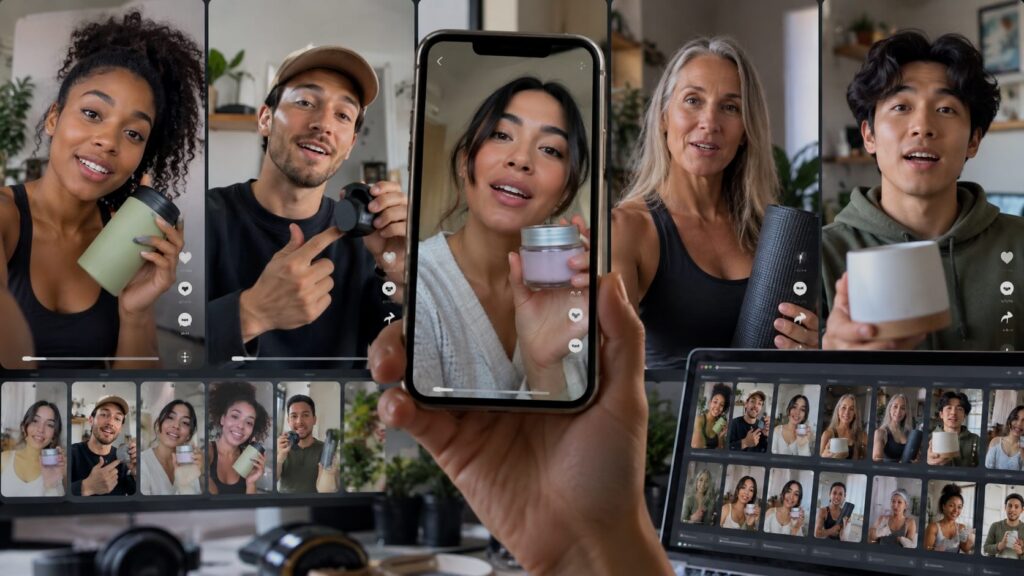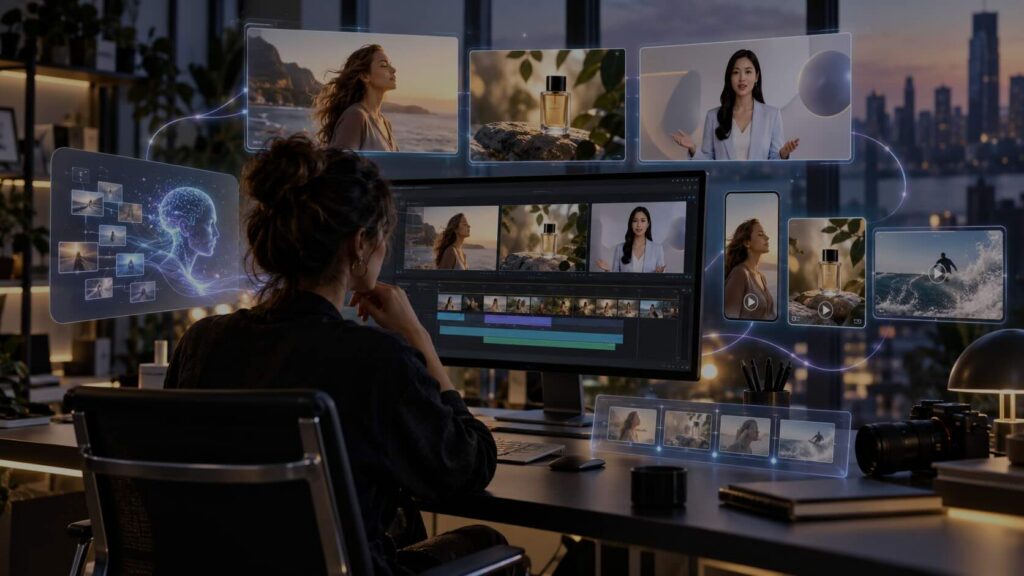

Quick answer: The best AI generated commercials so far include Kalshi’s roughly $2,000 spot that aired during the 2025 NBA Finals, Coca-Cola’s AI-rebuilt holiday campaign and Toys”R”Us’s AI-made brand film. What they teach: AI can cut production costs dramatically and make it cheap to test several versions, but the concept, script and creative direction still decide whether the ad works. For a different, creator-style approach, see our guide to AI UGC video ads.
Updated September 2026.
Introduction
Something shifted in AI advertising in 2025. The question stopped being “can AI generate a commercial?” and became “what kind of commercial should it generate, and for whom?” The examples that followed that shift are genuinely instructive—not because of the technology involved, but because of the creative decisions behind how each brand chose to use it.
We’ve collected the most significant AI-generated commercials from the past 12–18 months: the viral, the cinematic, the experimental, and the strategically smart. For each one we cover what was made, how it was made, what it cost or saved, and—most importantly—what the lesson is for any brand considering AI video production.
A note on sourcing: Gisteo has been producing video for businesses since 2011, with AI Cinematic production now a core part of our work. We have a practitioner’s view of these tools—Veo 3, Kling, Runway, and others—and what they can and can’t do in a real production context. That perspective shapes how we read these examples.
How AI Advertising Got Here: A Three-Phase Story
It’s useful to understand where we are in the evolution of AI-generated advertising before diving into specific examples. The capability shift has been fast, but it didn’t happen all at once.
| Phase | What Changed | Representative Tools | What Brands Could Do |
| Phase 1: AI-assisted targeting and copy (2018–2022) | Machine learning optimized ad delivery, bidding, and headline testing. Generative text helped create copy variants at scale. | Google Smart Bidding, Meta Advantage+, Jasper, Copy.ai | Improve ad performance efficiency; generate and test copy variations; automate media buying decisions |
| Phase 2: Generative image assets (2022–2024) | Text-to-image tools made visual asset creation fast and cheap. Brands could generate product visuals, lifestyle imagery, and social graphics without a photoshoot. | Midjourney, DALL·E, Adobe Firefly, Stable Diffusion | Create visual ad assets without shoots; generate localization variants; test visual concepts before committing to production |
| Phase 3: Full generative video (2024–present) | Text-to-video and image-to-video tools can now generate complete video commercials—motion, dialogue, sound effects, and narrative—without a crew on location. | Google Veo 3, Runway Gen-4.5, Kling 3.0, Sora 2, Higgsfield, Seedance 2.0 | Produce broadcast-quality video commercials; localize at scale; create lifestyle and cinematic footage at a fraction of traditional production cost |
We’re firmly in Phase 3 now—especially with the recent launch of Seedance 2.0 (probably the best model yet) and the examples below show what that looks like in practice, from a $2,000 primetime TV spot to a global campaign producing thousands of localized variants without a single photoshoot.
At Gisteo, we really ramped up our AI video production in July of 2025, with this viral hit about a fictional product that helps…ehem…improve the smell one might leave behind:
The Best AI Generated Commercials: 8 Examples Worth Studying
1. Kalshi — The $2,000 NBA Finals Spot That Changed the Conversation
Brand: Kalshi (prediction market platform) • Tool: Google Veo 3, Gemini, ChatGPT, CapCut, Adobe Premiere • Cost: ~$2,000 in AI generation costs • Timeline: 2–3 days • Placement: ABC television, YouTube TV • Game 3 of the 2025 NBA Finals
This is the AI commercial that made the advertising industry stop and pay attention. During Game 3 of the 2025 NBA Finals—one of the most expensive advertising slots in US television—Kalshi aired a 30-second spot that looked like nothing else in the break. A farmer floating in a pool of eggs. An alien downing a pitcher of beer. A runaway bride escaping police on a golf cart. The tagline: “The world’s gone mad. Trade it.”
The spot was created entirely by AI filmmaker PJ Accetturo, working alone. He used Gemini and ChatGPT to generate prompt lists, then rendered each shot individually in Google’s Veo 3, running 300–400 clip generations to assemble the 15 that made the final cut. Editing was handled in CapCut and Adobe Premiere. No crew. No actors. No location fees. No studio time.
Kalshi had initially sought quotes from traditional production companies. The figures came back in the six-to-seven figure range with timelines that didn’t fit the campaign window. They pivoted to AI and hired Accetturo. The AI generation costs alone came to roughly $2,000—a 95% reduction compared to traditional production for a comparable national TV spot.
The results: over 20 million impressions across TV and social media. More than 3 million views on Kalshi’s X account within the first week. Covered by NPR, Ad Age, CNBC, and dozens of marketing publications. And a level of earned media attention that the production budget alone never could have purchased.
The lesson: The Kalshi ad works because the creative brief was right, not because the AI was impressive. Accetturo was given a single direction—make the most unhinged NBA Finals commercial possible—and he used AI to execute a specific creative vision at speed. The chaos was intentional and brand-relevant: Kalshi lets you trade on anything, and the ad visualized that premise. AI gave the creative direction legs it couldn’t have had with a traditional production budget and timeline. The lesson isn’t “AI makes ads cheap.” It’s “AI makes bold creative decisions executable at the speed bold creative decisions require.”
2. Coca-Cola — Reimagining an Iconic Holiday Classic
Brand: Coca-Cola • Campaign: 2024 holiday season • Placement: Global broadcast and digital
Coca-Cola’s holiday advertising is among the most iconic in the world. The brand’s Christmas trucks and wintry village scenes have run for decades and carry genuine emotional weight for viewers across generations. In 2024, the brand rebuilt that imagery using AI—atmospheric cityscapes, falling snow, festive characters, and the familiar visual language of the Coke Christmas universe, regenerated with generative video tools.
The execution was visually rich. The AI-generated scenes captured the atmospheric warmth of the original while adding a level of visual detail and environmental scale that would have been extremely expensive to produce through traditional CGI or live action. Snowflakes, glowing windows, crowds in winter coats—the scenes had the production quality of a high-budget animated production.
Audience reaction was divided. Visually, most viewers acknowledged the quality. Emotionally, a portion felt the AI version lacked the warmth of the original—that something ineffable about the human creative process behind the classic campaign didn’t survive the transition to generative production. It became one of the more discussed examples of the gap between visual fidelity and emotional resonance in AI advertising.
The lesson: AI can match or exceed the visual quality of legacy advertising—but emotional resonance is not a production quality variable. It’s a creative and brand equity question. For Coca-Cola’s Christmas campaign, the specific emotional weight the original carried was inseparable from the fact that real people made it. Brands attempting to recreate legacy emotional associations with AI face a different challenge than brands building new associations from scratch. Use AI to create new brand moments rather than to replicate established ones where the “human-made” quality is part of the point.
3. Toys “R” Us — First Major Brand AI Film at Cannes Lions
Brand: Toys “R” Us • Tool: OpenAI Sora • Milestone: First major brand AI film screened at Cannes Lions
In 2024, Toys “R” Us became the first major brand to premiere a fully AI-generated film at Cannes Lions, the advertising industry’s most prestigious festival. The film told an origin story: the childhood dream of founder Charles Lazarus that eventually became the Toys “R” Us brand, with Geoffrey the Giraffe as the iconic mascot appearing throughout.
The production was handled by Native Foreign and built using OpenAI’s Sora. Every scene—environments, characters, narrative progression—was generated synthetically. No traditional filming. No animation studio. The result was a short brand film with genuine narrative structure: a beginning, a character arc, and an emotional payoff built around nostalgia and the magic of childhood.
The Cannes premiere sparked significant industry debate about AI’s role in creative advertising—some celebrating the creative possibility, others raising questions about creative authorship and the displacement of traditional filmmakers. But the fact of the premiere itself was significant: the advertising industry’s most high-profile creative stage had its first fully AI-generated brand film, and it was a coherent, emotionally structured piece of storytelling.
The lesson: The Toys “R” Us film demonstrates that AI video is capable of sustained narrative—not just impressive individual clips, but a story with a beginning, middle, and end that creates emotional identification. The strategic context matters: Toys “R” Us was reviving a dormant brand with deep nostalgia equity. An AI-generated origin story tapped that nostalgia while signaling forward-looking innovation simultaneously. The format was right for the brief. Brands with strong legacy and nostalgia equity are well-positioned to use AI brand films for the same reason—the audience brings the emotional investment; the production needs only to honor it.
4. H&M — Digital Twins at Global Production Scale
Brand: H&M • Approach: AI digital twins of 30 real models • Scale: Thousands of consistent assets across global campaigns • Models retained: Full consent and compensation from the 30 models whose likenesses were used
H&M took a different approach to AI advertising than most of the examples in this article. Rather than generating new characters or environments from scratch, the brand created AI-powered digital twins of 30 real models—with the models’ full consent and continued compensation—and used those digital twins to generate advertising content at global scale.
The business case was straightforward: scheduling 30 models across dozens of global markets, with different seasonal collections, different campaign themes, and different platform format requirements, is a logistical and financial challenge that grows exponentially with scale. Digital twins allowed H&M to produce thousands of consistent, high-quality model images and video clips without the scheduling constraints, travel costs, and coordination overhead of traditional photoshoots.
The campaign produced consistent visual identity across markets while compressing production timelines significantly. The same model could appear in a winter campaign for Sweden, a summer campaign for Australia, and a sale campaign for the US—generated from the digital twin without a single additional shoot day.
The lesson: H&M’s approach illustrates AI’s most practically valuable advertising application for large brands: not replacing creativity, but eliminating the logistical and financial friction that prevents consistent creative execution at global scale. The creative decisions—which models, which aesthetic, which brand positioning—remain human. AI handles the production execution across formats, markets, and seasonal variations. This is the model that most large brands will eventually adopt: AI as a production scaling layer on top of human creative direction, not a replacement for it.
5. Amaysim — National TV Ad with a Two-Person Team
Brand: Amaysim (Australian telecom) • Tools: Adobe Firefly (image generation), Runway (motion) • Team: 2-person in-house creative team • Timeline: Under 2 weeks • Result: Aired nationally on digital and broadcast channels
Amaysim is an Australian telecom brand positioned around being agile, cost-effective, and consumer-first. When they needed a national advertising campaign, those brand values made AI production a natural fit—and a two-person in-house creative team built and delivered the entire ad using AI tools in under two weeks.
The workflow was clean: Adobe Firefly generated each image frame individually, and Runway handled the motion design that turned those frames into video. Every visual in the ad was AI-generated. No traditional filming, no full production crew, no weeks-long shoot schedule. The production aligned with the brand’s identity—lean, fast, and resourceful.
The finished ad aired nationally across digital and broadcast channels—functionally indistinguishable in production quality from traditionally produced telecom advertising. The cost reduction was significant. More importantly, the timeline compression meant the brand could respond to market conditions and campaign opportunities with a speed that traditional production schedules don’t allow.
The lesson: Amaysim demonstrates the case for AI advertising that’s most relevant for mid-market brands: not cutting production quality, but decoupling production quality from production overhead. A two-person team delivering a broadcast-quality national ad in under two weeks is a structural change in what’s possible, not just a cost saving. For brands that need to move at market speed—responding to trends, seasonal moments, competitive shifts—AI production eliminates the “it takes three months to produce a commercial” constraint that has historically made agile advertising impossible.
6. Atera — End-to-End AI Production for B2B Software
Brand: Atera (B2B IT management software) • Tools: Runway, Sora, ElevenLabs • Approach: End-to-end generative AI • Every frame: AI-generated
Atera made every frame of their campaign using AI. The concept: a fictional world where IT professionals live without the stress and chaos that normally defines their work, thanks to Atera’s automation platform. The campaign visualized a specific professional aspiration—the absence of the pain the product solves—through generative AI environments, characters, and scenarios built with Runway, Sora, and ElevenLabs for voice.
For a B2B software company, this is a notable creative and production decision. B2B advertising has historically leaned toward demonstration and feature explanation rather than emotional and aspirational storytelling. Atera took the opposite approach: don’t show the software interface, show the life the software makes possible. The AI production tools made that kind of conceptual, environment-driven storytelling accessible at a B2B budget.
The fully generative workflow—from scene creation to voice—demonstrated that AI video production is viable for the entire advertising pipeline, not just specific components. Script to screen without traditional production at any stage.
The lesson: The Atera campaign is the most instructive example for B2B technology companies specifically. AI production makes aspirational, emotional storytelling—the kind that has historically required large production budgets—accessible for B2B advertising contexts. The insight that “show the life, not the software” applies to explainer videos and brand advertising alike. And for B2B brands where the buying cycle is long and competitive differentiation is often unclear, emotionally resonant brand advertising is an underused asset. AI production removes the budget barrier that previously made it impractical.
7. eToro — Photorealistic Investing Ad with Google DeepMind
Brand: eToro (investment platform) • Tools: Google Veo 2, Google DeepMind • Distinction: One of the first major brand campaigns produced with Veo 2.
eToro partnered directly with Google DeepMind to produce a campaign using Veo 2—making it one of the first major brand campaigns to use that model commercially. The brief: create cinematic, photorealistic footage that demystifies investing and makes the concept accessible to new audiences who find financial advertising intimidating.
The result was visually distinctive. Veo 2’s photorealistic output produced scenes with the depth of field, lighting quality, and material realism of professionally filmed content—not the stylized or obviously synthetic aesthetic that earlier AI video tools tended to produce. eToro used this to build a campaign that felt premium without the premium production overhead.
The campaign’s positioning was also smart: rather than demonstrating the platform’s features, it used cinematic imagery to communicate that investing was accessible, understandable, and within reach for ordinary people. The visual quality reinforced the message—if the brand looked sophisticated, the implication was that the platform was sophisticated enough to be trusted.
The lesson: eToro demonstrates the “visual quality as trust signal” application of AI cinematic production. In financial services, healthcare, and other high-stakes categories, production quality communicates credibility before a word of copy lands. AI Cinematic production now delivers that quality without the production cost historically required to achieve it. For brands in trust-sensitive categories—where looking credible is a precondition for being heard—this is one of AI advertising’s most practically valuable applications.
8. Headway — Millions of Personalized Ad Variants at Scale
Brand: Headway (edtech platform) • Approach: AI-generated personalization at scale • Result: Millions of unique ad variations tailored to user segments • Outcome: Improved A/B testing performance and ad efficiency (Business Insider)
Headway’s AI advertising approach is different from every other example in this article. Rather than producing one exceptional creative piece, Headway used AI to produce millions of unique ad variations—each tailored to specific user segments, behavioral signals, and audience contexts.
The premise is straightforward: a single ad shown to a million people is less effective than a million slightly different ads each matched to the person seeing it. AI makes that personalization economically viable. The creative direction—the messaging, the value proposition, the tone—remains human. AI handles the generation of variants that adapt the creative to each specific audience context.
The performance improvement was measurable. Headway reported better A/B testing outcomes and improved ad efficiency across their campaigns compared to their previous one-size-fits-all approach. The volume of variants that AI enabled wouldn’t have been economically feasible through traditional creative production.
The lesson: Headway represents the long-term trajectory of AI in advertising more clearly than any of the other examples here. The ultimate application isn’t producing one great AI commercial—it’s producing the right commercial for each specific viewer. Personalization at this scale has been a marketing aspiration for decades. AI is making it operationally achievable. For brands with large addressable audiences and the data infrastructure to support segmentation, this is the highest-ROI application of AI advertising—not because any individual ad is exceptional, but because the system produces better outcomes across the entire audience.
All 8 Examples: At a Glance
| Brand | Tool(s) | What Made It Notable | Key Metric / Outcome | Best Lesson For |
| Kalshi | Veo 3, Gemini, CapCut | First major fully AI-generated primetime TV commercial; aired during NBA Finals Game 3 | $2K production cost; 20M+ impressions; 3M+ X views in first week | Small/mid brands with bold creative brief and tight timelines |
| Coca-Cola | Generative video AI | Iconic brand reimagined classic holiday campaign with AI atmospheric imagery | High visual quality; divided audience reaction on emotional warmth | Understanding limits of AI for legacy emotional brand associations |
| Toys “R” Us | OpenAI Sora | First major brand AI film at Cannes Lions; full narrative origin story | Industry milestone; proof of AI sustained storytelling capability | Legacy brands building nostalgic brand narratives |
| H&M | Generative AI (digital twins) | AI digital twins of 30 real models; thousands of global campaign assets | Eliminated photoshoot logistics across global markets; massive scale | Large brands scaling consistent creative across global markets |
| Amaysim | Adobe Firefly + Runway | National TV ad built by 2-person in-house team in under 2 weeks | Broadcast-quality result; ~70% cost reduction vs. traditional | Mid-market brands needing broadcast quality on lean budgets |
| Atera | Runway + Sora + ElevenLabs | End-to-end AI B2B campaign; aspirational storytelling, no UI footage | Full generative pipeline from concept to delivery | B2B technology brands making emotional, non-demo advertising |
| eToro | Google Veo 2 + DeepMind | One of first major brand campaigns using Veo 2; photorealistic investing ad | Cinematic quality; trust-building in financial services context | Trust-sensitive categories where visual quality = credibility |
| Headway | Generative AI (personalization) | Millions of unique ad variants tailored to user segments | Improved A/B performance; better efficiency across full audience | High-volume advertisers with audience segmentation data |
Key Insights from the AI Advertising Shift
Looking across these eight examples, a few patterns emerge that are more useful than any individual case study.
The creative brief still determines everything
None of these campaigns succeeded because of the AI tools involved. They succeeded because the brief was right. Kalshi’s ad was “make the most unhinged commercial possible”—and the AI executed that vision with precision. Toys “R” Us wanted a nostalgic origin story—and AI provided the production capacity to build it. H&M needed consistent global production scale—and AI delivered it.
In every case, a human made the strategic and creative decision. AI handled the execution. The brands that will get the most out of AI advertising are the ones that invest in the brief, not the ones that treat AI as a creative replacement.
Cost reduction is real but it’s not the point
Kalshi’s $2,000 production cost got all the headlines. Amaysim’s 70% cost reduction is genuinely significant. But the more transformative implication of those numbers isn’t that advertising is cheaper—it’s that the cost of experimentation has collapsed. When a commercial costs $2,000 to produce, you can test five versions. When it costs $500,000, you test one and hope. The ability to run multiple creative hypotheses simultaneously—and kill the ones that don’t work without catastrophic financial consequences—is the structural change that matters most.
Emotional resonance is not a production quality variable
The Coca-Cola example is the most important cautionary note in this list. AI can match the visual quality of any human-produced content. It cannot automatically match the emotional resonance of creative work where the human process itself is part of what the audience values. For brands rebuilding legacy emotional associations through AI—particularly in categories like food, holiday, nostalgia, and family—this is a genuine creative risk that production quality alone doesn’t resolve.
The AI aesthetic is a creative choice, not a limitation
Kalshi’s chaotic, lo-fi aesthetic wasn’t a failure of AI generation quality—it was the intended output. The GTA-style visual energy was right for the brand and the moment. The Toys “R” Us film aimed for emotional warmth and achieved it. The eToro campaign aimed for cinematic photorealism and achieved that. The tools are capable of a wide visual range. The question is whether the creative direction is specific enough to define what the video should look and feel like before a single prompt is written.
Phase 3 is just getting started
Veo 3.1, Kling 3.0, Runway Gen-4.5, and, now, Seedance 2.0 are all materially more capable than the tools that produced these examples. The Kalshi ad was made with Veo 3 in its early availability window. What’s possible now, and what will be possible in 12 months, is significantly beyond what these campaigns demonstrate. Brands that are establishing AI advertising workflows today are building capability and institutional knowledge that will compound over the next two to three years as the tools continue to improve.
What This Means for Your Brand: Where Gisteo Fits
Gisteo produces AI Cinematic video and AI Avatar video for businesses that need professional-quality content without traditional production timelines and budgets. We’ve been watching this space develop for years—and actively producing with Veo 3, Kling, and Runway as part of our AI Cinematic production workflow.
The commercials in this article are instructive not because every brand should produce a $2,000 chaotic primetime spot—most shouldn’t. They’re instructive because they demonstrate what’s now possible with the right creative brief, the right tool selection, and professional production judgment about what the video is trying to accomplish.
That last part—production judgment—is what distinguishes a video that works from one that looks technically impressive and doesn’t convert. Every Gisteo AI Cinematic project starts with a strategic discovery process: what is this video supposed to accomplish, who is it for, and what specific action does it need to drive? The tools are the execution layer. The strategy and scripting are where the work happens.
Gisteo AI Cinematic: From $3,500. Cinematic-quality AI video using Veo 3, Kling, Seedance 2.0 and Runway under professional creative direction. Full scripting, visual planning, voiceover, and editing. Typical timeline: 2–3 weeks.
Gisteo AI Avatar: From $1,000. Professional AI presenter video with full scripting, branded design, VO, and production management. Typical timeline: 1–2 weeks.
Traditional custom animation: From $3,500. Custom 2D animation, character animation, and motion graphics for flagship brand assets. Typical timeline: 4–8 weeks.
Frequently Asked Questions
Are AI generated commercials actually airing on TV?
Yes. Kalshi’s AI-generated spot aired on ABC during Game 3 of the 2025 NBA Finals—one of the most-watched sporting events in the US. It was reviewed and approved by network standards. Amaysim’s fully AI-generated ad aired nationally across broadcast and digital channels in Australia. The barrier to broadcast for AI-generated content is creative and compliance review—the same review process as any traditionally produced commercial. The production method is irrelevant to broadcast standards.
How much does it cost to produce an AI-generated commercial?
It varies significantly by the complexity of the brief, the production approach, and who’s producing it. Kalshi’s AI generation costs were approximately $2,000—but that figure doesn’t include the creative fee for the filmmaker. At a professional studio like Gisteo, AI Cinematic production starts at around $3,500 for a 60-second video with full scripting, creative direction, voiceover, and editing. (That $3,500 starting price is for longer cinematic films; shorter social media videos cost less, and we offer multi-video packages.) Traditional commercial production for a comparable broadcast spot typically runs $100,000–$500,000 and up. The cost advantage of AI production is real and significant—the variable is whether the creative judgment behind the production is professional or not.
Will viewers know a commercial was made with AI?
For most well-produced AI commercials, most viewers won’t identify the footage as AI-generated. The Kalshi ad’s intentionally chaotic aesthetic reads as stylistic rather than technical failure. The eToro and H&M campaigns were indistinguishable from traditionally produced content in terms of visual quality. The tells that marked earlier AI video—physics artifacts, character drift, generic composition—are substantially reduced in current-generation tools. The more relevant question is whether the video is compelling, not whether it’s identifiable as AI.
What kinds of brands should be using AI for commercials now?
Any brand with a clear creative brief and a realistic production budget. The examples in this article span prediction markets, global fashion, telecom, B2B software, financial services, and edtech—there’s no single vertical where AI commercial production is uniquely appropriate. The more relevant variables are: Does the brand have a specific creative objective? Is the timeline tight enough that traditional production isn’t feasible? Is the budget range better served by AI production quality than traditional mid-range production? If yes to any of these, AI commercial production is worth a serious conversation.
What’s the difference between using AI tools yourself and hiring a studio like Gisteo?
Access to AI video tools and knowing how to use them to produce a commercial that works are different things. The tools are accessible—Veo 3, Runway, and Kling all have subscription plans. What’s not included in a subscription is the strategic scripting, shot routing, prompt engineering depth, iteration judgment, voiceover direction, editing, and post-production that determine whether the footage becomes a video that does its job. Kalshi’s $2,000 ad was made by an experienced AI filmmaker with advertising industry background. The AI generation costs were $2,000. The expertise behind those 300–400 generations was not.
The Shift Has Already Happened
The debate about whether AI belongs in advertising is over. It aired during the NBA Finals. It screened at Cannes. It’s generating thousands of localized campaign variants for global fashion brands. It’s powering national telecom campaigns made by two-person teams in two weeks.
What’s still being worked out is the craft layer—the understanding of when AI production serves a creative brief and when it undermines it, which tools route to which shot types, how to write briefs precise enough to get usable output, and how to build production workflows that combine AI efficiency with human creative judgment at every strategic decision point.
That craft layer is what Gisteo brings to AI Cinematic production. Fourteen years and 3,000+ projects of understanding what makes a video work—applied to the tools that are redefining what’s possible.
If you’re ready to explore what AI video production could do for your brand, schedule a free consultation now!