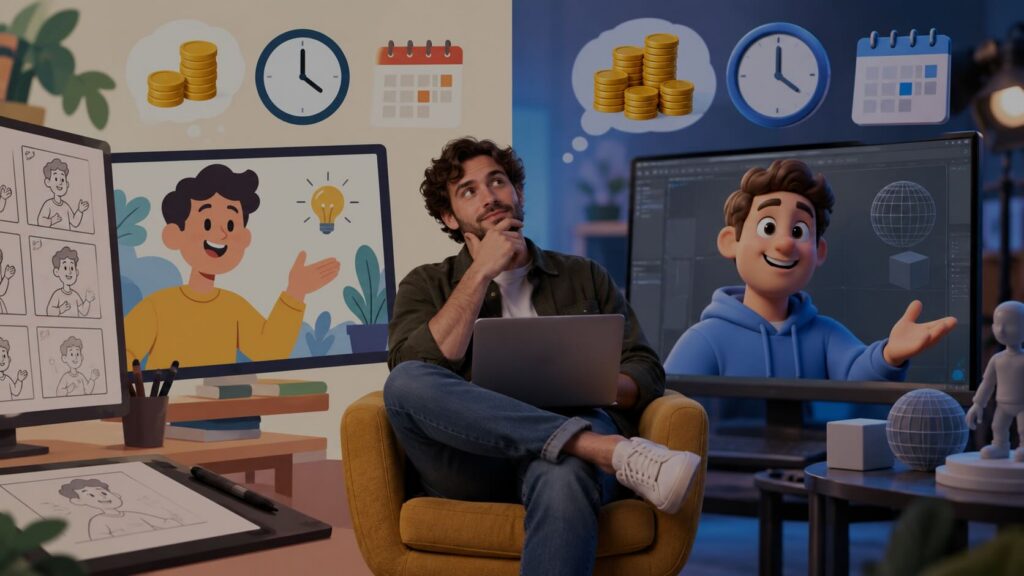

Quick answer: AI generated videos are videos where AI creates some or all of the visuals and voice, most commonly as cinematic AI scenes or AI avatar presenters. They can cut production time from weeks to days and cost far less than filming, but the results still depend on a strong script, creative direction and human quality control. At Gisteo, AI avatar videos start at $1,000 and cinematic AI videos at $3,500.
Updated September 2026.
Introduction
Imagine creating a polished, professional video commercial in just six hours—no actors, no camera crew, no location scouts— in a single day.
That’s exactly what happened one Sunday in July 2025 when my fake commercial for “TootCravia™” went from concept to viral sensation, racking up thousands of views across Reddit and LinkedIn. The twist? Every frame was created using AI generated videos technology. Here’s the video in question:
This isn’t science fiction anymore. AI generated videos are transforming how businesses create content, slashing production times from weeks to days and cutting costs substantially. Whether you’re a marketing director drowning in content demands or a small business owner stretching a tight budget, understanding AI generated videos isn’t optional, it’s essential.
In this comprehensive guide, you’ll discover everything you need to know about AI generated videos: what they are, how they work, when to use them, and how to create professional content that actually converts. Let’s dive in.
What Are AI Generated Videos?
AI generated videos are digital video content created using artificial intelligence technology rather than traditional filming methods. Instead of cameras, actors, and production crews, these videos rely on sophisticated algorithms that can generate realistic visuals, speech, and motion from text descriptions or other inputs.
At their core, AI generated videos use machine learning models trained on millions of hours of video footage to understand how objects move, how lighting works, how humans speak, and how scenes are composed. When you provide a prompt or script, these models synthesize new video content that mimics real-world footage.
There are two primary types of AI generated videos dominating the market right now and what we’re focusing on at Gisteo:
AI Avatar Videos
Feature realistic digital presenters who deliver scripted content directly to camera. Think of them as virtual spokespersons who can speak any language, never get tired, and don’t require makeup or wardrobe. These avatars are placed in virtual environments and excel at training videos, product explanations, and straightforward messaging.
Cinematic AI Videos
Create Hollywood-style scenes from scratch—complete with AI-generated characters, dynamic camera movements, and rich visual storytelling. These short clips (typically 8 seconds each) can be stitched together to create compelling brand videos, promotional content, or emotional narratives without any live-action filming.
The key difference from traditional video? AI generated videos eliminate most of the traditional production pipeline while maintaining professional quality—no casting calls, no location permits, no weather delays.
The Rise of AI Generated Videos
The numbers tell a compelling story.
But it’s not just about market size. Marketers who adopt AI video tools commonly report producing videos much faster. These aren’t marginal improvements—they represent fundamental shifts in how businesses approach video content.
The “faceless video” trend on YouTube exemplifies this shift. According to Clippie’s 2025 analysis, the top 100 faceless YouTube channels gained 340% more subscribers than face-based channels in 2025, with some creators earning $500K-$5M+ annually. These aren’t hobbyist projects—they’re professional content businesses built entirely on AI video technology.
Several factors are driving this explosive growth. First, remote work normalized video-first communication, creating insatiable demand for video content. Second, attention spans continue to shrink, making video the most effective medium for capturing audience attention. Third, the technology finally crossed the quality threshold where AI generated videos became indistinguishable from traditional production for many use cases.
Perhaps most importantly, businesses realized that traditional video production simply couldn’t keep pace with modern content needs. When you need 20 training videos updated quarterly across five languages, traditional filming becomes prohibitively expensive. AI generated videos solve this scalability problem elegantly.
Types of AI Generated Videos
Understanding the different types of AI generated videos helps you choose the right approach for your specific needs. Each style has distinct strengths, limitations, and ideal use cases.
AI Avatar Videos
AI avatar videos put a photorealistic digital human at the center of your content. These virtual presenters can deliver any script you write, in any of dozens of languages, with natural-sounding speech and appropriate facial expressions.
The avatar speaks directly to camera from a virtual environment—typically an office, studio setting, or neutral background. Modern AI avatar technology captures subtle nuances like breathing patterns, natural pauses, and micro-expressions that make the presentation feel authentically human.
These videos work exceptionally well for training modules, customer onboarding sequences, product tutorials, FAQ explanations, and internal communications. They’re particularly valuable when you need consistent messaging delivered by the same “person” across multiple videos, or when you want to create localized content in languages your team doesn’t speak.
The limitations are straightforward: avatars can’t interact with physical objects, perform actions beyond basic gestures, or move between different scenes. They’re presenters, not actors. If your script requires someone to demonstrate a product, walk through a facility, or perform specific actions, AI avatars won’t work.
Cinematic AI Videos
Cinematic AI videos represent the cutting edge of text-to-video generation. You describe a scene in text—”a woman in a business suit walks confidently through a modern office lobby at sunset, golden light streaming through floor-to-ceiling windows”—and AI creates that scene from scratch.
These aren’t stock footage clips or templated animations. The AI generates original visuals including character appearance, setting details, camera movement, lighting, and even native sound effects. The results can be stunningly cinematic, with production value that rivals expensive professional shoots.
Current technology generates clips up to 8 seconds long, which are then edited together with music, voiceover, graphics, and transitions to create complete videos. This clip-based approach works beautifully for brand stories, promotional teasers, social media content, book trailers, and emotional narratives where visual impact matters more than lengthy dialogue.
The creative possibilities are virtually limitless. Want to show your software product being used in a sleek Tokyo office at night? A cozy coffee shop in Paris? A futuristic laboratory? AI can generate these settings without location scouting, travel, or permits. Need diverse representation in your brand video? AI can create exactly the characters you need.
However, cinematic AI videos require more post-production expertise than avatar videos. Maintaining visual consistency across multiple clips takes skill, and the 8-second limitation means you’ll need strategic editing. The technology can also occasionally produce uncanny details or misinterpret complex prompts, requiring human oversight and refinement.
Hybrid Approaches
The most sophisticated AI video producers combine both styles strategically. An onboarding video might use an AI avatar to welcome new employees, then cut to cinematic AI scenes showing company culture and values, then return to the avatar for step-by-step instructions.
This hybrid approach leverages the strengths of each style while minimizing their individual limitations. It also creates more dynamic, engaging content that holds viewer attention better than a single format throughout.
Benefits of AI Generated Videos
The advantages of AI generated videos extend far beyond simple cost savings. Understanding these benefits helps you identify opportunities where AI video can transform your content strategy.
Speed and Efficiency
Traditional video production operates on timelines measured in weeks or months. Pre-production planning, casting, scheduling, filming, and post-production create lengthy workflows that don’t align with modern business velocity.
AI generated videos compress this timeline dramatically. Many projects move from concept to completed video in days rather than weeks. Need to update training content because a product feature changed? With AI, you can have a revised video ready in 24-48 hours instead of scheduling a complete reshoot.
This speed advantage becomes exponential when you’re creating video series. Producing 12 training modules that would take months with traditional filming might take just two weeks with AI video production.
Cost Effectiveness
The economics are striking. Traditional professional video production typically costs $3,000-$10,000+ per finished minute when you factor in crew, equipment, talent, location fees, and post-production. For many businesses, this pricing makes video an occasional luxury rather than a regular content tool.
AI generated videos can reduce these costs dramatically, depending on complexity and volume. The gap is easy to see when you compare AI tool subscriptions (often $50–200 a month) with traditional editor rates (often $50–150 an hour). At Gisteo, AI avatar videos start at $1,000 for the first 30 seconds, plus $500 for each additional 30 seconds, a fraction of traditional costs. Even sophisticated cinematic AI productions come in at price points that were unthinkable for equivalent quality just two years ago.
This affordability transforms video from a special occasion medium into an everyday communication tool. Suddenly it makes financial sense to create video explanations for every product feature, video answers to every FAQ, and video updates for every company announcement.
Scalability
Perhaps the most transformative benefit is scalability. Once you’ve developed a script and approach, creating variations becomes trivially easy with AI generated videos.
Need that training video in Spanish, French, German, and Japanese? With AI avatars, you’re not hiring new voice talent and re-recording—you’re selecting different language options. The same avatar delivers the same content in perfect Portuguese with proper pronunciation.
Need to create personalized video messages for 100 different clients? Variables and automation make this possible with AI in ways that would be absurd with traditional filming.
Want to A/B test different messaging approaches? Generate three versions of the same video with different scripts and see which performs best, all for less than a single traditional video would cost.
Consistency and Control
AI generated videos give you perfect consistency across your video library. The same avatar can appear in hundreds of videos over years, always looking identical, always on-brand, never aging or changing appearance.
You also gain unprecedented control over every aspect of production. Don’t like how a sentence was delivered? Adjust the script and regenerate just that section. Want to change the background? Swap it instantly. Need to update statistics or information? Make the changes without re-filming anything.
This level of control is particularly valuable for regulated industries where accuracy and compliance matter. Legal, healthcare, and financial services companies can maintain exact messaging while still leveraging video’s engagement advantages.
Multilingual Capabilities
Global businesses face a persistent challenge: creating localized content for different markets. Traditional video production for multilingual content means multiple shoots with different talent, or expensive dubbing that often feels disconnected from the visuals.
AI generated videos solve this elegantly. A single script becomes videos in 50+ languages with native-sounding speakers and appropriate cultural adaptations. The avatar’s lip movements sync perfectly with each language. Graphics and text overlays are automatically translated and properly formatted.
This capability democratizes global content creation. Small businesses can now create professional marketing videos for international markets without prohibitive localization costs.
How AI Generated Videos Are Made
Understanding the technology behind AI generated videos helps you appreciate both their capabilities and current limitations.
Text-to-Video Generation
The foundation of cinematic AI videos is text-to-video technology, where algorithms transform written descriptions into visual content. These models were trained on millions of video clips paired with text descriptions, teaching the AI to understand the relationship between language and visual concepts.
When you write “a golden retriever running through a field of sunflowers at sunset,” the AI doesn’t search a database for matching footage. Instead, it generates entirely new video content by synthesizing pixels based on its learned understanding of dogs, fields, sunflowers, and sunset lighting.
Current generation models like Runway ML, Veo 3, and Sora can produce remarkably sophisticated results. They understand camera movement, lighting consistency, object physics, and visual composition at levels that approach professional cinematography.
However, these models work best with clear, specific prompts. Vague descriptions produce unpredictable results. The most effective prompts specify subject, action, setting, lighting, camera angle, and mood. Professional AI video producers have developed prompt engineering skills similar to traditional cinematography—they know how to describe scenes that the AI will render effectively.
AI Avatar Creation
AI avatars begin with video footage of real people. Actors are filmed speaking hundreds or thousands of phrases from multiple angles, providing training data for the AI model. The AI learns that person’s unique facial structure, expressions, speech patterns, and mannerisms.
Once trained, the avatar can “speak” any new script by synthesizing video of that person saying words they never actually said. The AI generates appropriate lip movements, facial expressions, head movements, and even breathing patterns that match the script naturally.
Modern avatar platforms offer diverse representation—different ages, ethnicities, genders, and presentation styles. Some platforms even allow you to create custom avatars from footage of your own team members, though this requires careful consideration of consent and usage rights.
The voice synthesis happens simultaneously. Text-to-speech AI has advanced to the point where synthetic voices sound natural, complete with proper emphasis, emotional tone, and conversational rhythm. The voice can be cloned from the original actor or selected from voice libraries.
The Human Creativity Element
Despite all this automation, human creativity remains central to effective AI generated videos. The technology is a powerful tool, but it requires skilled direction to produce professional results.
Professional AI video production involves strategic decisions about messaging, pacing, tone, and visual approach. It requires strong scriptwriting to create content that connects with audiences. It demands video editing expertise to assemble AI-generated clips into coherent narratives with proper pacing and flow.
The best AI video producers combine technical AI skills with traditional production expertise. They understand story structure, visual composition, audience psychology, and brand strategy. They know when AI is the right tool and when human elements should be incorporated.
This human oversight also provides quality control. AI can occasionally produce odd artifacts, inconsistencies, or misinterpretations. Experienced producers catch these issues and either correct them through prompt refinement or strategic editing.
WATCH: A Gisteo AI video production for a Chicago-based SEO firm:
Use Cases for AI Generated Videos
The versatility of AI generated videos makes them suitable for a remarkably wide range of business applications.
Training and Employee Onboarding
Corporate training represents one of the highest-value applications for AI generated videos. Traditional training videos become outdated quickly, but updating them through traditional production is expensive enough that companies often delay updates, leaving employees learning from obsolete content.
AI avatar videos solve this perfectly. Create comprehensive training modules where a consistent instructor guides employees through procedures, policies, and best practices. When processes change, update the script and regenerate affected sections in days rather than months.
The multilingual capabilities prove especially valuable for global companies. Create training once, deploy it across all markets in local languages with native speakers, ensuring consistent quality worldwide.
Employee onboarding becomes more engaging and scalable with AI video. Instead of reading policy manuals, new hires watch personalized welcome videos, department introductions, and role-specific training sequences—all featuring consistent company branding and messaging.
Marketing and Brand Storytelling
AI generated videos enable marketing teams to operate at unprecedented velocity. Need 20 social media videos for a product launch? Generate them in a week. Want to test different messaging approaches? Create multiple versions and A/B test them affordably.
Cinematic AI videos excel at brand storytelling. Craft emotional narratives about your company values, customer success stories, or product benefits using rich visuals that would cost tens of thousands to produce traditionally. These videos work beautifully for homepage hero sections, social media campaigns, and event presentations.
The speed advantage matters enormously for timely campaigns. Traditional video production timelines mean you’re planning holiday campaigns in summer. With AI video, you can respond to trends, news, and opportunities much more nimbly.
WATCH: A fantastical Gisteo AI production for a property management recruitment firm:
Product Demonstrations and Explainers
Complex products require clear explanations. AI avatar videos make excellent product explainers where a knowledgeable presenter walks viewers through features, benefits, and use cases. On-screen graphics, animations, and text overlays can highlight key points while the avatar maintains human connection.
Software and SaaS companies particularly benefit from AI-generated product demos. Show screen recordings of your interface while an avatar explains functionality, or use cinematic AI to create aspirational scenes of teams collaborating using your solution.
These videos can be embedded on product pages, used in email campaigns, featured in sales presentations, and leveraged across customer touchpoints—maximizing the return on your content investment.
Internal Communications
Corporate communications teams struggle to make company announcements engaging. AI generated videos transform boring email updates into compelling video messages from leadership.
Imagine quarterly business reviews where an AI avatar presents results with animated charts and graphics. Company policy updates delivered by a consistent company spokesperson. Department updates that employees actually watch because they’re more engaging than text documents.
The scalability allows for personalization too. Generate variations of the same update customized for different departments, regions, or roles—each receiving information most relevant to them.
Social Media Content
Social media’s insatiable appetite for fresh content makes AI generated videos invaluable. Create attention-grabbing social clips, Instagram reels, TikTok videos, and LinkedIn posts at the volume modern platforms demand.
The faceless video trend proves that audiences embrace AI-generated content when it’s entertaining, informative, or valuable. Educational content, industry insights, how-to videos, and thought leadership pieces all work effectively in AI-generated formats.
UGC-style videos using AI avatars can deliver product recommendations, customer testimonials, or expert advice with authenticity that resonates on social platforms.
Customer Support and FAQs
Video FAQ libraries transform customer support from reactive to proactive. Instead of answering the same questions repeatedly, create comprehensive video answers that customers can access 24/7.
AI avatars make this scalable. Generate videos answering common questions, troubleshooting issues, or walking customers through common tasks. The videos maintain consistent tone and quality while reducing support ticket volume.
As new questions emerge, add new videos to your library quickly without traditional production delays or costs.
AI Generated Videos vs. Traditional Video Production
Choosing between AI and traditional video production requires understanding the tradeoffs involved. Neither approach is universally superior—context matters.
Cost Comparison
Traditional professional video production typically costs $5,000-$15,000 for a simple 2-3 minute explainer video. More complex productions with actors, multiple locations, or sophisticated post-production easily reach $20,000-$50,000+. Corporate brand videos or commercials can cost six figures.
AI avatar videos might cost $500-$2,000 for similar length, while cinematic AI productions range from $3,000-$8,000 depending on complexity. The cost difference can be dramatic.
However, this comparison isn’t entirely apples-to-apples. Traditional production offers certain qualities that AI can’t yet match: authentic human presence, perfect visual continuity, complex interactions, and that intangible polish of professional cinematography.
Timeline Comparison
Traditional video production timelines span 4-8 weeks for straightforward projects and can extend to months for complex productions. This includes pre-production planning, scheduling, filming days, and post-production editing.
AI generated videos can be completed in days or 1-2 weeks. The speed advantage compounds when creating multiple videos or updating existing content—tasks that would require complete re-shoots traditionally.
This speed isn’t just about efficiency—it enables agility. Your business can respond to opportunities, trends, or needs with video content while traditional production would still be in planning stages.
Quality Considerations
Video quality encompasses multiple dimensions: visual polish, audio quality, authenticity, emotional resonance, and professional presentation.
Traditional video production, when done well, achieves unmatched visual quality. Real humans in real environments with professional lighting and cinematography create authentic moments that resonate emotionally. Complex interactions, subtle performances, and nuanced storytelling remain strengths of human-captured video.
AI generated videos have closed the quality gap significantly. Avatar videos achieve professional presentation quality suitable for most business applications. Cinematic AI can produce stunning visuals that rival expensive productions.
However, AI has limitations. Avatars feel slightly less authentic than real people for some viewers. Cinematic AI can occasionally produce uncanny details or inconsistencies. Extended close-ups of faces remain challenging. Complex physical interactions or precise continuity between shots requires careful work.
The quality question ultimately depends on your specific needs and audience expectations. For training, explainers, and most business communication, AI quality exceeds requirements. For premium brand films, emotional storytelling, or content where authenticity is paramount, traditional production might be worth the investment.
When to Use Each Approach
Choose AI generated videos when:
- You need content quickly (days, not weeks)
- Budget is limited or you need multiple videos
- Content will require regular updates
- You need multilingual versions
- Scalability and volume matter
- Consistency across videos is important
- The content is instructional, informational, or educational
Choose traditional video production when:
- Authenticity and emotional connection are critical
- You need complex human interactions or performances
- The project is a flagship brand piece with premium expectations
- Physical product demonstrations require real handling
- Your audience demographic skews toward skepticism of AI
- Visual continuity and perfection are non-negotiable
- Budget allows and timeline permits traditional production
Consider hybrid approaches when:
- You want premium quality with some cost savings
- Different video types serve different purposes in your campaign
- You’re building a video library with varying needs
- You want to test AI while maintaining traditional options
Many sophisticated companies use both strategically—traditional production for hero brand content, AI for the long tail of supporting videos.
Tools and Platforms for Creating AI Generated Videos
The AI video landscape features numerous platforms, each with distinct strengths, weaknesses, and ideal use cases.
Leading AI Avatar Platforms
Synthesia pioneered commercial AI avatar videos and remains an industry leader. Their platform offers 140+ diverse avatars, 120+ languages, and intuitive editing tools. It’s particularly strong for corporate training and internal communications, with features like screen recording integration and collaborative editing.
HeyGen emphasizes ease of use and creative flexibility. Their avatar quality is exceptional, with natural expressions and movements. The platform excels at marketing content and social media videos, with templates and creative tools that streamline production.
Colossyan targets enterprise training and learning content specifically. Their platform includes interactive elements, quizzes, and branching scenarios that make training videos more engaging and effective.
WATCH: A Gisteo AI avatar video, created as part of an ongoing business training course:
Cinematic AI Video Tools
Runway ML offers professional-grade text-to-video generation with sophisticated motion control and creative tools. It’s favored by video editors and creative professionals for the flexibility and quality it provides.
Veo 3 from Google represents cutting-edge AI video generation with impressive prompt adherence and visual quality. It’s particularly strong at camera movements and maintaining consistency across longer clips.
Sora 2 from OpenAI has demonstrated remarkable capabilities in early previews, with extended clip lengths and stunning visual quality. Limited access makes it less practical currently, but it represents where the technology is heading.
Why Professional Services Matter
While these platforms offer DIY capabilities, creating truly effective AI generated videos requires more than tool access. Professional services like specialized AI video agencies bring:
Strategic Expertise: Understanding which style, tone, and approach will actually achieve your business goals rather than just producing videos.
Script Writing: Crafting compelling narratives optimized for video format and AI capabilities, not just adapting text documents.
Production Skills: Knowing how to prompt AI effectively, combine multiple tools, and troubleshoot common issues.
Post-Production Polish: Editing, sound design, graphics, and finishing touches that elevate AI-generated content to professional standards.
Quality Control: Catching and correcting AI artifacts, inconsistencies, or awkward moments before delivery.
Brand Alignment: Ensuring every video reflects your brand voice, values, and visual identity consistently.
DIY platforms work well for simple projects with modest expectations. Professional services become valuable when video quality directly impacts business results, when you lack in-house video expertise, or when you need strategic guidance on video content strategy.
Best Practices for AI Generated Videos
Success with AI generated videos requires more than just using the tools—it demands strategic thinking about content, presentation, and deployment.
Crafting Effective Scripts
The script makes or breaks any video, but AI generated videos have specific considerations. Write conversationally, using natural language that sounds good when spoken aloud. Avoid long, complex sentences that challenge both AI speech synthesis and viewer comprehension.
Structure scripts with clear segments and natural breaks. This helps with pacing and makes editing easier. For avatar videos, aim for 150-170 words per minute—slightly slower than normal speech to ensure clarity.
Include guidance for tone and emphasis. While AI has gotten better at interpreting context, explicit notes help: “say this enthusiastically,” “pause here for emphasis,” “deliver this point seriously.”
For cinematic AI videos, write detailed scene descriptions. Don’t just describe what happens—specify camera angles, lighting, mood, and visual style. “Medium shot of a confident businesswoman reviewing documents at a glass desk in a minimalist office, soft afternoon light from windows, shallow depth of field” produces much better results than “woman working at desk.”
Choosing the Right Style
Match video style to content purpose and audience expectations. AI avatars work best for educational content, explanations, announcements, and straightforward messaging where a human presence adds connection but doesn’t need to be a specific real person.
Cinematic AI shines for emotional storytelling, brand positioning, promotional content, and situations where visual impact matters more than dialogue. It’s particularly effective for social media where stopping the scroll requires immediate visual interest.
Consider your audience’s AI familiarity and attitudes. Some demographics embrace AI content enthusiastically, while others remain skeptical. B2B audiences often accept AI avatars readily for functional content, while B2C contexts might require more authentic approaches depending on industry.
Maintaining Brand Consistency
AI generated videos should feel like natural extensions of your brand, not disconnected pieces of content. Establish clear brand guidelines for your AI videos:
Visual Identity: Use consistent backgrounds, colors, graphics, and lower thirds that match your brand standards. Many platforms allow custom backgrounds and branded templates.
Tone and Voice: Choose avatars whose presentation style matches your brand personality. A formal financial services company needs different avatar energy than a playful consumer brand.
Message Consistency: Ensure scripts align with your brand voice, key messages, and positioning. AI makes production easy, but doesn’t replace the need for strategic messaging.
Quality Standards: Set clear quality thresholds for what you’ll publish. Just because AI can generate videos quickly doesn’t mean every output should go public.
Optimizing for Platform and Context
Different platforms and contexts demand different approaches. LinkedIn videos might feature professional avatars delivering business insights in 60-90 seconds. Instagram reels might use rapid-cut cinematic AI clips with bold text overlays and trending audio.
Website homepage videos should grab attention quickly while communicating value proposition clearly. Training videos can run longer with detailed explanations and on-screen instructions.
Consider viewing context too. Mobile-first platforms need bold, clear visuals and text that’s readable on small screens. Emails require strong thumbnails that drive clicks. Landing pages need videos that support conversion goals specifically.
WATCH: a recent Gisteo AI production for an a group benefitting indigenous people in Canada:
Quality Control Processes
Implement consistent review processes before publishing AI generated videos. Check for:
Accuracy: Verify all factual claims, statistics, product details, and company information. AI doesn’t fact-check your script.
Audio Quality: Ensure speech sounds natural without robotic artifacts, proper pronunciation of industry terms and company names, and appropriate pacing throughout.
Visual Consistency: Look for jarring cuts, inconsistent lighting between scenes, unusual artifacts or distortions, and overall professional polish.
Brand Alignment: Confirm the video reflects your brand standards, supports your strategic goals, and would make your team proud to share.
Having fresh eyes review videos catches issues that creators miss after watching the same content repeatedly during production.
Common Challenges and Limitations
Understanding current limitations helps set realistic expectations and plan around constraints effectively.
The Eight-Second Constraint
Current text-to-video AI generates clips typically limited to 8 seconds (though this is extending to 12-16 seconds with latest models). This constraint shapes how you approach cinematic AI videos—you’re essentially creating a series of micro-scenes edited together rather than continuous footage.
This limitation requires strategic editing. Plan your video as a series of distinct moments rather than continuous action. Use transitions, cutaways, text overlays, and voiceover to bridge between clips smoothly.
The good news: this constraint is temporary. Text-to-video models are rapidly extending generation length. Longer continuous generations of 30–60 seconds are quickly becoming standard.
Consistency Challenges
Maintaining visual consistency across multiple AI-generated clips remains challenging. The same character might appear slightly different between scenes. Lighting and color grading can shift. Environmental details change unpredictably.
Professional AI video producers work around this through careful prompt engineering, strategic editing, color correction in post-production, and sometimes regenerating clips multiple times to find consistent results.
For avatar videos, consistency is less problematic—the same avatar maintains identical appearance across videos, which is actually an advantage over traditional production where human actors age, change hairstyles, or aren’t available for re-shoots.
The Uncanny Valley
Some AI-generated humans fall into the “uncanny valley”—looking almost but not quite human in ways that feel unsettling. This is less common with modern platforms but hasn’t been completely solved.
Avatars from leading platforms like Synthesia and HeyGen largely avoid this issue now, with natural movements and expressions that most viewers accept easily. Cinematic AI characters in fast-paced scenes rarely trigger uncanny valley responses, but extended close-ups can still feel slightly off.
The best mitigation: choose platforms with proven quality, use avatars and styles you’ve tested with your audience, and don’t force AI into use cases where authentic human presence truly matters.
Limited Interaction Capabilities
AI avatars can’t hold props, interact with products, or perform physical actions. They’re presenters, not actors. Cinematic AI can show characters doing things, but controlling precise interactions remains difficult.
This limits certain video types. Product demonstrations often need real humans handling real products. Tutorial videos might require actual screen recordings rather than AI generation. Some stories need genuine human performance to land emotionally.
Work within these constraints by combining AI with other content types. An avatar can introduce a product demo that then shows screen recordings. Cinematic AI can set emotional tone, then cut to real footage for key moments.
Prompt Interpretation Challenges
AI doesn’t always interpret prompts as intended. You might request “a professional office” and get something too modern or too traditional. Specific details like “exactly three people” or “holding a red coffee mug” might be ignored or misinterpreted.
This unpredictability requires iteration. Professional producers generate multiple versions, select the best results, and refine prompts based on what works. It’s part artistic direction, part trial and error.
The skill of effective prompting improves with practice. Learning what language produces desired results, how to control specific visual elements, and when to accept “good enough” rather than pursuing perfection all come with experience.
Current Technical Limitations
AI video technology continues advancing rapidly, but current limitations include:
- Hand and finger movements often look unnatural
- Complex physics (liquids, cloth, hair) remain challenging
- Lip sync is excellent but not absolutely perfect
- Background details can shift between shots
- Text within generated scenes is usually garbled
- Fast motion sometimes creates artifacts
- Very specific actions or poses may not generate as intended
These limitations are improving monthly. Each new model release pushes boundaries further. But for now, they shape what’s possible and require workarounds or acceptance of imperfection.
The Future of AI Generated Videos
Looking ahead reveals exciting developments that will further transform video content creation.
Real-Time Generation
Near-future AI will generate video in real-time or near-real-time. Imagine adjusting a script and seeing the updated video immediately, or having AI avatars respond conversationally to viewer questions in live sessions.
This capability enables interactive video experiences where content adapts dynamically to individual viewers, personalized video messages generated at scale, and rapid iteration during creative development without waiting for processing time.
Extended Generation Length
As models improve, generation length will extend from seconds to minutes of continuous footage. This eliminates the clip-stitching constraint, allowing for more natural long-form content with perfect continuity.
Entire videos might be generated in single passes, maintaining character consistency, lighting continuity, and spatial relationships throughout. This will make AI-generated narrative content dramatically more feasible.
Improved Realism and Control
Visual quality continues advancing toward photorealism that’s indistinguishable from traditional filming. Specific control over characters, environments, camera movement, and timing will become more precise.
We’re approaching a future where you can art-direct AI videos as thoroughly as you’d direct a traditional shoot, specifying exact camera angles, performances, and visual details with confidence they’ll be rendered accurately.
Multi-Modal Integration
Future AI will seamlessly integrate video with other modalities—automatically generating accompanying audio, graphics, captions, and even interactive elements. A single script input might produce not just video, but complete multimedia experiences optimized for different platforms.
Voice cloning will become more accessible, allowing companies to create branded voice avatars from existing recordings. Visual style transfer will let you define a look once and apply it consistently across unlimited videos.
Personalization at Scale
AI video will enable personalization previously impossible. Imagine sales outreach videos where the avatar addresses each prospect by name, references their company specifically, and discusses their particular pain points—all generated automatically from CRM data.
Training videos could adapt to individual learning styles, pacing, and knowledge levels. Marketing videos might adjust messaging based on viewer demographics or behavior patterns.
Democratization of Video Production
As tools become more accessible and affordable, video production will democratize further. Small businesses, solopreneurs, non-profits, and individuals will create professional-quality video content that would have required significant budgets previously.
This democratization will flood the internet with video content, making quality, strategy, and authentic human creativity even more important differentiators than today.
Getting Started with AI Generated Videos
Ready to explore AI generated videos for your business? Here’s a practical framework for getting started effectively.
Assess Your Video Needs
Begin by identifying where video could add value in your business. Common starting points include:
- Product or service explanations that currently rely on text
- Training content that’s outdated or text-based
- FAQ responses you answer repeatedly
- Marketing messages that aren’t breaking through
- Internal communications that employees ignore
- Customer onboarding that’s confusing or inconsistent
Prioritize based on impact and simplicity. Your first AI video project should address a genuine business need without requiring the most complex production.
Define Success Criteria
Be specific about what success looks like. Are you trying to reduce support tickets by 20%? Increase training completion rates? Generate more qualified leads? Improve employee engagement scores?
Clear success criteria help you evaluate whether AI video is actually delivering value and guide decisions about style, messaging, and deployment strategy.
Choose Your Approach
Decide between DIY and professional services based on:
DIY Makes Sense When:
- You have internal video editing skills
- Projects are simple and low-stakes
- Volume is low (occasional videos)
- Budget is extremely constrained
- You want to experiment and learn
Professional Services Make Sense When:
- Video quality directly impacts business results
- You lack in-house video expertise
- You need strategic guidance on messaging and approach
- Volume justifies the investment
- Time-to-market matters significantly
- Brand consistency is critical
Many businesses start with professional services for flagship videos, then potentially bring some production in-house as they learn the ropes and understand what works.
Start with a Pilot Project
Don’t commit to producing 50 videos immediately. Start with a pilot project that:
- Addresses a real business need
- Has defined success metrics
- Keeps scope manageable
- Allows learning without major risk
- Can be completed relatively quickly
This pilot teaches you what works for your business, audience, and use cases before scaling up production.
Test with Your Audience
Don’t assume—test. Show draft videos to representative audience members and gather feedback. Do they find the avatar engaging or off-putting? Does the messaging land effectively? What questions remain unanswered?
A/B testing different approaches reveals what resonates. Try avatar versus cinematic styles. Test different script angles. Experiment with video length. Let data guide
Partner with Experienced Producers
While DIY platforms make AI video accessible, partnering with experienced AI video production services can accelerate success significantly. Professional producers bring:
- Years of experience with what works and what doesn’t
- Access to premium tools and techniques
- Strategic guidance on messaging and positioning
- Quality control that ensures professional results
- Efficiency that saves time even if it costs more upfront
Look for production partners who demonstrate both AI technical skills and traditional video expertise. The best AI video agencies combine cutting-edge technology with human creativity and strategic thinking.
Measure and Iterate
Once your videos are deployed, track performance rigorously. Monitor engagement metrics like view duration, completion rates, and click-through rates. Measure business outcomes like conversion rates, support ticket reduction, or training completion.
Use these insights to refine your approach. Which video styles perform best? What script structures drive action? How does video length impact engagement? Continuous improvement based on real data separates effective AI video strategies from those that simply produce content.
Conclusion: The AI Video Revolution Is Here
AI generated videos represent more than just a new production technique—they’re fundamentally changing what’s possible in video content creation. The technology has matured to the point where businesses of any size can leverage professional video content at scale, speed, and affordability that were unimaginable just two years ago.
The advantages are clear: faster production, lower costs and easy scaling across languages and markets. These aren’t incremental improvements—they’re transformational advantages that enable entirely new content strategies.
However, AI is a tool, not a magic solution. The most successful AI video implementations combine technological capability with human creativity, strategic thinking, and authentic brand voice. Understanding when to use AI, how to use it effectively, and when traditional approaches make more sense separates strategic video content from mere novelty.
Whether you’re creating training modules for a global workforce, marketing videos for product launches, or customer support content that reduces ticket volume, AI generated videos offer compelling advantages. The technology will only improve from here—generation length extending, quality increasing, and capabilities expanding.
The question isn’t whether AI will transform video production—it already has. The question is whether you’ll leverage this transformation to gain competitive advantage, or watch competitors pull ahead while you’re still planning traditional shoots.
Ready to explore how AI generated videos can transform your content strategy? The technology is mature, the benefits are proven, and the opportunity is now.
Ready to Create Professional AI Generated Videos?
At Gisteo, we’ve been creating compelling videos since 2011, and we’ve fully embraced AI video production to deliver studio-quality content at unprecedented speed and affordability. Whether you need AI avatar videos for training and communication or cinematic AI productions for brand storytelling, we combine cutting-edge technology with human creativity to create videos that actually drive results.
Schedule a free consultation to discuss your video needs and discover how AI generated videos can help you scale your content, reduce costs, and engage your audience more effectively.