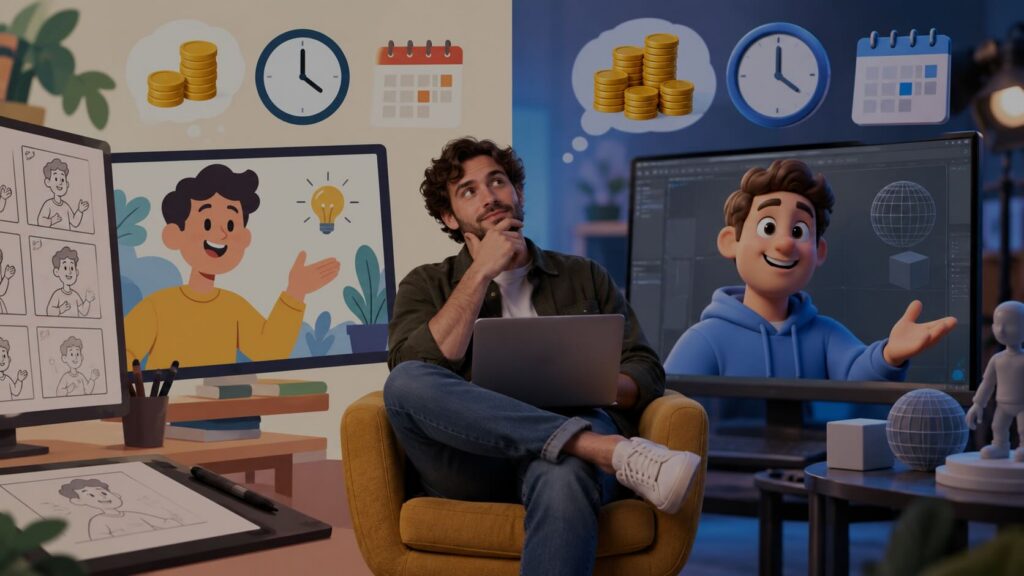

Quick answer: To create a brand mascot, start from your brand’s personality and your audience, then design a simple, recognizable character with a clear role in your story. Document it in a character guide with turnarounds, expressions, colors and rules. Consistency, not cleverness, is what turns a character into a brand asset.
Introduction
Some of the most recognizable brands are recognized by a character, not a logo. A mascot gives your explainer videos a familiar face. Viewers remember it, it can carry a message across dozens of videos, and it gives your brand a personality that a logo alone can’t.
But a mascot is a long-term commitment. Here’s how to create one that works, and how to keep it looking like the same character from video to video.
Should your brand have a mascot?
A mascot is a good fit when:
- You’ll make many videos. A mascot pays off across a series, not a single piece.
- Your product is abstract. Software, insurance and finance benefit from a character that makes ideas concrete.
- You want warmth. A character softens technical, serious or intimidating topics.
- Your audience scrolls fast. A familiar character is recognizable in the first second.
A mascot may be the wrong choice when your brand is built on a founder’s personal presence, when your audience expects a strictly formal tone, or when you only need one video.
What makes a good explainer video mascot?
| Quality | Why it matters |
|---|---|
| Simple shape | Recognizable at small sizes and in a split second |
| Clear personality | Viewers should know how it will react before it does |
| Brand colors | It should look like it belongs to you, not a cartoon anyone could own |
| Expressive | Faces, eyes and posture carry emotion without words |
| Animation-friendly | Fewer tiny details mean faster, more affordable animation |
| A defined role | Guide, helper, customer stand-in or product personified |
Here’s a recent Gisteo project featuring a brand mascot.
How do you design a brand mascot?
1. Start with your brand, not a drawing. Write down three to five personality words (for example: helpful, calm, a little funny). Every design decision should support them.
2. Decide the mascot’s role. Is it a guide who explains things? A stand-in for your customer? Your product with a face? The role shapes how it behaves in every video.
3. Explore several directions. Ask your studio for a few early sketches in different directions: human, animal, object or abstract. Pick based on personality and audience, not just what’s cute.
4. Refine one character. Work on proportions, colors, face and silhouette. Test it small, in black and white, and next to your logo.
5. Test it in motion. A character that looks great standing still can be awkward to animate. A short animation test shows how it moves and emotes, and a quick storyboard of the character in a real scene helps too.
6. Build the character guide. This is the step most brands skip, and the one that matters most.
What goes in a character guide?
A character guide (sometimes called a model sheet or character bible) keeps your mascot consistent no matter who animates it. It should include:
- Turnaround: front, three-quarter, side and back views
- Expression sheet: happy, surprised, confused, thinking and more
- Pose examples: how it stands, points, walks and reacts
- Exact colors: hex, RGB and CMYK values
- Size relationships: how big it is next to people, props and your logo
- Personality notes: what it would and wouldn’t do or say
- Do’s and don’ts: no stretching, no off-brand colors, no out-of-character behavior
How do you keep a mascot consistent with AI video tools?
AI tools can now put characters into cinematic scenes, but consistency is their weak spot. A character can change subtly from shot to shot. To keep control:
- Use reference images from your character guide in every generation.
- Use character reference features that many AI video tools now offer for keeping a character stable across shots.
- Keep a human reviewer who knows the character and rejects shots where it drifts.
- Combine methods. Use custom animation for close-ups and key moments, and AI for wider scenes where small differences are less noticeable.
Who owns the mascot?
Make sure your contract gives your company ownership of the character and all design files, including the source artwork and character guide. At Gisteo, you own the final video, and the source files are available as a buy-out (or included with our Unlimited plan). If you’d like to register the character as a trademark, talk to a trademark attorney.
Final thoughts
A great mascot is simple, has a clear personality and stays consistent. The design is the fun part. The character guide is what makes it a lasting brand asset.
Gisteo has designed custom characters for 2D and 3D explainer videos since 2011 (not sure which fits? See 2D vs. 3D animation). Custom animated explainers start at $3,500 for 60 seconds. Don’t hesitate to schedule a consultation, tell us about your brand, and we’ll help you create a character worth keeping.
FAQs
How much does it cost to create a brand mascot?
It depends on how much exploration, refinement and documentation you need. Many brands develop a mascot as part of their first explainer video.
Can I use AI to design a mascot?
AI can help with early exploration, but a human designer should refine the final character and build the character guide. Check ownership terms too: in some places, purely AI-generated designs may not be protectable in the same way as human-created work.
Should my mascot talk?
It depends on your videos. A speaking mascot needs a consistent voice. A silent one relies on expression and a narrator.
How do I keep my mascot consistent across different agencies?
Give every agency the same character guide and source files, and have one person on your team approve all appearances.