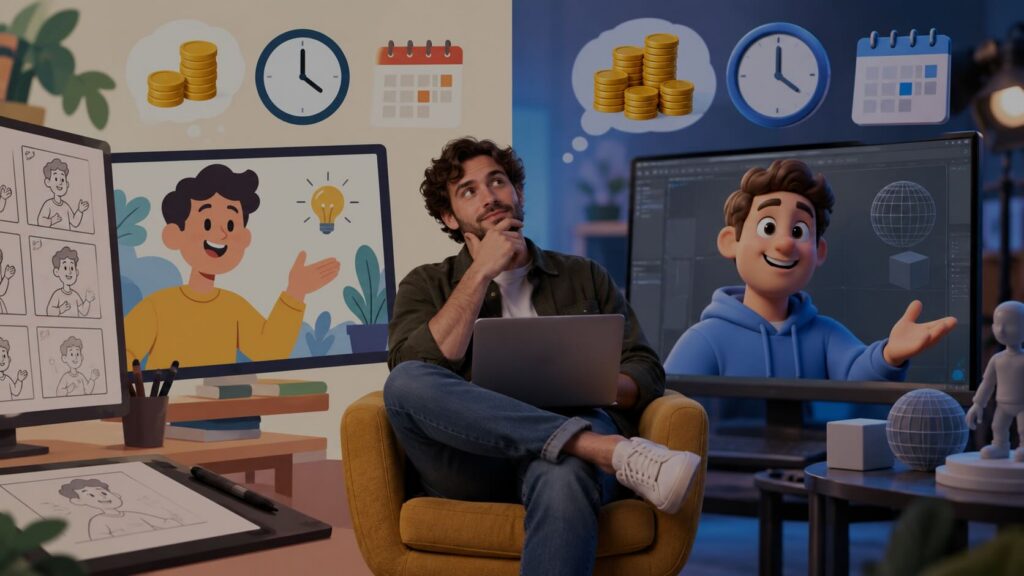

Quick answer: 2D animation is flat, faster to produce and more affordable, which makes it the right choice for most explainer videos about services, software and ideas. 3D animation adds depth and realism, so it’s worth the extra cost and time when you need to show a physical product, a machine or a space from every angle.
Introduction
When companies plan an explainer video, the 2D vs. 3D question comes up early. 3D often looks more impressive in a showreel, so it’s tempting to assume it’s the better option. It isn’t always. The right style depends on what you need to show, not on which looks more advanced.
What’s the difference between 2D and 3D animation?
2D animation works on a flat plane: height and width. Characters, icons and scenes are drawn or built as flat artwork and animated. Most explainer videos you’ve seen, from startup homepages to training videos, are 2D.
3D animation builds objects as digital models with height, width and depth. A virtual camera can move around them, and lighting and materials make them look solid and often realistic.
There’s also a middle ground, 2.5D animation, which uses layered 2D artwork and camera tricks to create a sense of depth without full 3D modeling.
How do 2D and 3D compare?
| 2D animation | 3D animation | |
|---|---|---|
| Look | Flat, illustrated, graphic | Depth, realism, solid objects |
| Cost | Lower | Higher |
| Timeline | Shorter | Longer (modeling, texturing, lighting and rendering add steps) |
| Changes late in production | Usually easier | Often costlier, especially after rendering |
| Best for | Services, software, concepts, processes, people | Physical products, machinery, medical devices, architecture |
| Brand style | Very flexible and easy to match to brand guidelines | Can match brands, but style exploration takes longer |
| Reuse | Assets easy to repurpose for social and web | Models can be reused for new angles and future videos |
Why is 3D animation more expensive?
3D animation has more production steps. Before anything moves, each object needs to be modeled, given materials and textures, lit and rigged if it moves. Then every frame has to be rendered, which takes computer time. Each step needs specialist skills.
Revisions also cost more in 3D. Changing a character’s color in 2D can be quick. In 3D, the same change might mean updating materials, relighting and re-rendering whole scenes.
When is 2D animation the better choice?
2D animation is usually the stronger choice when:
- You’re explaining a concept or service. Insurance, finance, consulting and HR ideas don’t need physical realism.
- You’re showing software. Screens, dashboards and workflows are flat by nature, and 2D handles them cleanly.
- You need characters with personality. 2D characters are expressive and quick to animate.
- Speed or budget matters. 2D gets you a polished video in less time and for less money.
- You’ll make many videos. A 2D style can be extended into a series efficiently.
When is 3D animation worth it?
3D earns its cost when:
- Your product is physical. Buyers want to see a device, component or machine from every angle.
- You need to show what’s inside. 3D can peel back a casing, slice through a part or follow fluid through a system.
- Realism builds trust. Medical devices, engineering and industrial products often benefit from accurate, realistic visuals.
- You’re showing spaces. Real estate, architecture and facility walkthroughs benefit from true depth.
- You’ll reuse the models. Once your product is modeled, new angles, features or campaigns cost less.
Can you combine 2D and 3D?
Yes. Many strong explainers use 2D for the story and characters and bring in 3D for the product moment. 2.5D can also give a 2D video depth without the full cost of 3D. And AI-generated footage is now another option for realistic scenes that don’t require modeling your exact product.
How do you decide?
Ask three questions:
- Does the viewer need to see a physical object in depth to understand it? If yes, consider 3D. If no, 2D is likely enough.
- What’s your budget and deadline? If either is tight, 2D gives you more for less.
- What will you do with the assets later? If you’ll make many product videos, a 3D model can pay for itself over time.
The bottom line
2D is the practical default for most explainer videos, and it’s the right choice more often than people expect. 3D is a specialist tool that’s worth the investment when depth, realism or physical products are central to your message.
Gisteo has produced 2D, 2.5D and 3D animation since 2011 across more than 3,000 projects. Our custom animated explainers start at $3,500 for 60 seconds. Contact us about your product or schedule a free consultation, and we’ll recommend the style that fits your message and budget.
FAQs
Is 3D animation better than 2D?
Neither is better overall. 3D is better for showing physical objects in depth. 2D is better for concepts, software and character-driven stories, and it’s faster and more affordable.
How much more does 3D animation cost than 2D?
It varies by project, but 3D is typically more expensive because it adds modeling, texturing, lighting and rendering. Complexity and realism level have the biggest effect on price.
How long does 3D animation take compared with 2D?
3D usually takes longer because of the extra production steps and render time. Revisions late in production also take longer in 3D.
What is 2.5D animation?
2.5D animation uses layered 2D artwork and camera movement to create depth. It sits between 2D and 3D in look and cost.
Can I use my product’s CAD files for 3D animation?
Often, yes. Existing CAD or 3D files can speed up modeling, though they usually need cleanup and optimization for animation.
Related: Budget under $5,000? See what animation studios deliver under $5,000.