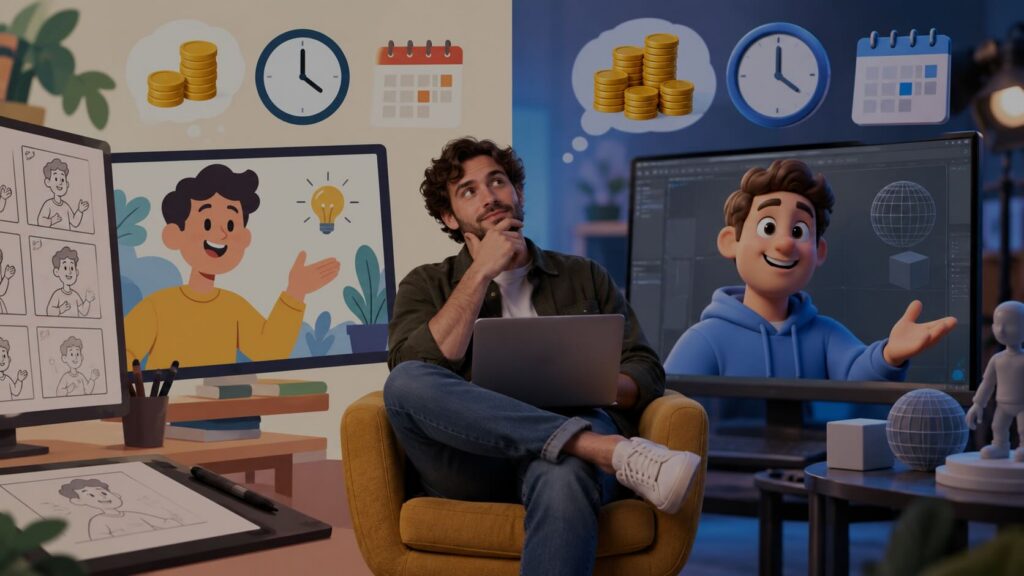

| WHAT ARE CUSTOMER EDUCATION VIDEOS?
Customer education videos are short, purpose-built videos that teach customers how to get value from a product or service. They include welcome videos, onboarding walkthroughs, feature tutorials, troubleshooting guides, and best-practice explainers. Done well, they reduce repeat support questions, accelerate adoption, and improve retention — because customers who understand a product actually use it. |
Introduction
Customer education videos work best when they are tied to a specific business job. For marketing, onboarding, product, and support teams, that job is simple to state and hard to execute: help customers understand value faster and ask fewer repeat questions.
Most companies get this half right. They produce one video, post it on the homepage or a help center page, and move on. Then the same support tickets keep arriving, activation rates stay flat, and the video quietly becomes shelfware.
Gisteo has produced explainer and education video content since 2011 — more than 3,000 projects for clients ranging from UPS, Oracle, Intel, Roche, Pfizer, Harvard, Bills.com and many more. This guide covers what we’ve learned about making customer education videos that actually change behavior: the formats that work, the structure behind an effective script, how to build a small library instead of a single catch-all video, and how to measure whether any of it is working.
Why Customer Education Videos Matter More Than Ever
The economics of customer education have shifted. Acquiring a new customer costs several times more than retaining an existing one, and in subscription businesses, retention is the whole game. A customer who never learns the product churns — not because the product failed, but because understanding did.
Video is the format most customers prefer for learning. People watch a 90-second walkthrough; they skim (or skip) a 900-word help article. Video also scales in a way that support teams do not. A single well-made troubleshooting video can answer the same question thousands of times without anyone opening a ticket.
There is a second, newer reason. AI assistants and answer engines increasingly summarize and cite educational content. Companies with clear, well-structured customer education videos — supported by transcripts, schema markup, and focused landing pages — are more likely to be the source those tools point to. Education content is no longer just a support asset. It’s a visibility asset.
The Gap Between Interest and Understanding
Most video projects begin with a surface-level request: make it shorter, make it more engaging, make it look modern. Those are reasonable goals, but they are not the point. The stronger question is what the viewer needs to understand, believe, or do after watching.
That question changes the entire structure of a project:
- A video for a skeptical buyer needs proof — evidence, examples, and credibility signals.
- A video for a new customer needs orientation — what to do first, where things live, what success looks like in week one.
- A video for a buying committee needs a shareable summary — something a champion can forward internally without a meeting.
- A video for employees needs context and a clear next step — why this matters and what changes on Monday.
Customer education videos live mostly in the second and fourth categories, but the discipline is the same across all of them: define the viewer, define the job, and let those two decisions drive format, length, and tone.
The Six Types of Customer Education Videos
“Customer education” is not one format. In practice, a healthy education program draws on six distinct video types, each solving a different problem:
1. Welcome videos
A short (60–90 second) video that greets new customers, sets expectations, and points them to the first meaningful action. The goal is emotional as much as informational: reduce buyer’s remorse and make the customer feel they chose well.
2. Onboarding walkthroughs
Step-by-step guidance through initial setup. These are the highest-ROI education videos for most companies because they directly affect activation — the moment a customer first experiences real value.
3. Feature tutorials
Focused videos on one feature at a time. Resist the urge to cover three features in one video. One video, one feature, one outcome. Shorter videos also perform better in help centers and search.
4. Troubleshooting guides
Videos built directly from your support ticket data. Pull the ten most common questions from your help desk and turn each into a two-minute video. This is the most measurable category: ticket volume on those topics should visibly drop.
5. Best-practice and use-case videos
These move customers from “I can use it” to “I use it well.” They show workflows, advanced techniques, and how similar customers get results. This category drives expansion revenue and feature adoption.
6. Release and update videos
Short announcements when the product changes. They protect the education library’s credibility — nothing erodes trust faster than a tutorial showing an interface that no longer exists.
Build a Library, Not a Video
Customer education works best as a small library rather than a single catch-all video. A welcome video, a setup video, a handful of feature videos, and two or three troubleshooting videos each solve a different problem — and each can be placed exactly where the customer needs it: inside the product, in onboarding emails, on help center pages, or in a sales follow-up.
Start small and deliberately. A practical first library looks like this:
- One welcome video (60–90 seconds)
- One core onboarding walkthrough (2–4 minutes, or split into chapters)
- Three feature tutorials, chosen by usage data or sales conversations
- Three troubleshooting videos, chosen by support ticket volume
That’s eight videos. Produced together, they share a visual system, a voice, and a template — which makes each additional video cheaper and faster than the last. Gisteo frequently structures projects this way: one primary production plus a set of companion assets, rather than eight disconnected one-offs.
Not every topic deserves video. Reference material, edge cases, and content that changes monthly are often better as written documentation. Video is strongest when clarity, confidence, or behavior change matters — and when the topic is stable enough that the video won’t be obsolete in a quarter.
What Makes Customer Education Videos Actually Work
A polished video can still fail if it is built on a fuzzy message. Production quality gets attention; message clarity gets results. Every effective education video we’ve produced shares the same simple spine:
- Name the situation. Meet the viewer where they are: “You’ve just connected your account. Here’s what to do next.”
- Clarify the problem or goal. One sentence on what this video helps them accomplish.
- Show the path. The steps, demonstrated visually, in the order the viewer will actually perform them.
- Explain the why where it matters. Not everywhere — just at the decision points where customers typically get confused or make the wrong choice.
- End with a next step. Watch the next video, try it yourself, or contact support for the edge cases.
A few production principles matter as much as the spine:
- Keep videos short. Two minutes is a target, not a limit — but every extra minute costs completion rate.
- Match visuals to the job. Screen recordings show what to click; animation explains why it matters and simplifies what’s complex. Most strong education libraries mix both.
- Caption everything. A large share of education video is watched on mute, in-app, or in open offices.
- Publish the transcript. It becomes searchable text for your help center, improves accessibility, and gives AI answer engines something to cite.
This is where Gisteo’s scripting process carries most of the weight. We turn raw notes, product details, and stakeholder input into a story viewers can follow — before anything gets animated or recorded. See our explainer video production page for how that process works step by step.
Your Options for Producing Customer Education Videos
Teams typically choose between four production paths. Each has a legitimate use case; the right choice depends on volume, stakes, and internal bandwidth.
| Approach | Typical cost | Speed | Quality consistency | Best for |
| DIY (in-house tools) | Staff time only | Fast per video, slow to systematize | Varies widely | Quick internal updates, temporary content |
| Freelancer | $500–$3,000/video | Depends on availability | Depends on the individual | One-off videos, tight budgets |
| Traditional agency | $10,000–$50,000+ | 6–12 weeks | High but slow | Flagship brand films |
| Gisteo (hybrid human-AI studio) | From $1,000 (AI Avatar); custom animation from $3,500; Unlimited Yearly for libraries | Days to a few weeks | Consistent across an entire library | Education libraries, explainers, multi-asset campaigns |
The hybrid model is what makes education libraries economically viable. Pure traditional production prices most companies out of building eight to ten videos. Pure AI production often lacks the message discipline that makes education content work. Gisteo combines human strategy and scriptwriting with AI-accelerated production — 14+ years of message craft, delivered at a pace and price that supports a full library. Budget-conscious teams can review our explainer video pricing before starting a conversation.
How Gisteo Produces Customer Education Videos
A Gisteo project can include strategy, scripting, storyboarding, animation, motion graphics, screen-capture integration, editing, voiceover direction, and channel-specific versions. For education libraries specifically, the process usually runs:
- We review your support ticket data, onboarding flow, and existing documentation to identify which topics deserve video.
- Message architecture. One core message per video, mapped against the customer journey so the library covers the moments that matter.
- Concise, conversational scripts built on the five-part spine above. You approve the words before we produce anything.
- Animation, motion graphics, AI-assisted visuals, or screen-recording hybrids — whatever the topic calls for, in a consistent visual system.
- Cutdowns for email and social, silent autoplay versions, vertical formats, and thumbnails, so each video works in every channel it will live in.
Because the same team handles the whole library, video six costs less and ships faster than video one — and everything looks and sounds like it came from the same brand. Our animated marketing videos page and portfolio show the range of styles available.
Measuring Customer Education Videos
Measurement should match the video’s job. A landing page video might be judged by conversion rate or demo requests. An onboarding video should be judged by activation and ticket deflection. Vanity metrics like raw view counts tell you almost nothing about whether education content is working.
| Goal | Useful signals |
| Awareness | Reach, watch time, qualified site visits |
| Conversion | CTA clicks, form fills, booked calls |
| Sales support | Email engagement, stakeholder shares, deal velocity |
| Onboarding & activation | Time-to-first-value, activation rate, onboarding completion |
| Support deflection | Ticket volume on covered topics, help center self-serve rate |
| Adoption & retention | Feature adoption, completion rates, fewer repeated questions |
The most convincing measurement for education content is before-and-after ticket data. Pick three high-volume support topics, produce videos for them, place the videos where customers hit the problem, and compare ticket volume 60 days later. It’s rarely subtle.
Distribution: Plan It Before Final Delivery
A homepage visitor, a LinkedIn scroller, a sales prospect, and a new customer do not need the same version of the same idea. When the production plan accounts for those differences upfront, one project creates value across the whole business instead of a single page.
For customer education videos specifically, the highest-leverage placements are:
- In-product — tooltips, empty states, and onboarding checklists, at the exact moment of confusion.
- Help center pages — embedded above the written article, with the transcript below for search.
- Onboarding email sequences — one video per email in a drip sequence beats one long video in email #1.
- Sales and CS follow-up — reps sharing the setup video before kickoff calls shortens the calls.
- YouTube and social — a public education library doubles as pre-sales proof that your product is learnable.
For many Gisteo projects, that means producing one primary video plus a set of supporting assets: shorter social edits, silent autoplay versions, sales-friendly links, thumbnail options, and email cutdowns. The message stays consistent while each channel gets a version that fits.
Questions to Answer Before Producing Customer Education Videos
Before producing any video in this category, the team should settle a few decisions that are easy to skip and expensive to fix later. The clearer these answers are upfront, the easier it is for Gisteo — or any creative partner — to make the video feel specific instead of interchangeable:
- Who exactly is the viewer, and what do they already know?
- What single idea should the viewer remember after the video ends?
- Where will the video appear first: in-product, help center, email, website, or sales follow-up?
- What proof points, screenshots, customer language, or brand details must be included?
- What next step should feel natural after watching?
- How will you measure success — and what’s the baseline today?
- Who owns keeping this video accurate when the product changes?
These questions also protect search performance. A focused article and a focused video are both easier to optimize because the keyword, headline, structure, and user intent all point in the same direction.
FAQs About Customer Education Videos
What are customer education videos?
Customer education videos are purpose-built videos that teach customers how to use and get value from a product or service. Common formats include welcome videos, onboarding walkthroughs, feature tutorials, troubleshooting guides, best-practice videos, and release updates. Their job is to speed up adoption and reduce repeat support questions.
How long should customer education videos be?
Aim for 60–90 seconds for welcome videos, 2–4 minutes for onboarding walkthroughs, and under 2 minutes for feature tutorials and troubleshooting videos. If a topic genuinely needs more time, split it into chapters rather than producing one long video — completion rates drop sharply after the two-minute mark.
How much do customer education videos cost?
Costs range from staff time (DIY) to $50,000+ (traditional agencies). Gisteo’s hybrid human-AI model starts around $1,000 for AI Avatar videos, with AI Cinematic and custom animation from $3,500, and an Unlimited Yearly subscription for teams building full education libraries. Producing videos as a batch with a shared visual system significantly lowers the per-video cost.
What’s the difference between customer education videos and explainer videos?
An explainer video persuades — it helps a prospect understand why a product matters, usually before purchase. Customer education videos instruct — they help an existing customer succeed after purchase. They often share production techniques and a visual style, which is why many companies produce both with the same partner for brand consistency.
Should customer education videos use animation or screen recordings?
Both, depending on the job. Screen recordings are best for showing exactly what to click. Animation and motion graphics are best for explaining concepts, simplifying complexity, and keeping content evergreen when the interface changes frequently. Most strong education libraries mix the two — and hybrids (animated framing around screen capture) often perform best.
How do you measure whether customer education videos are working?
Match the metric to the video’s job: activation rate and time-to-first-value for onboarding videos, ticket deflection for troubleshooting videos, feature adoption for tutorials, and completion rates across the library. The clearest test is before-and-after support ticket volume on the topics your videos cover.
How many customer education videos do we need to start?
Eight is a practical first library: one welcome video, one onboarding walkthrough, three feature tutorials chosen by usage data, and three troubleshooting videos chosen by ticket volume. Start there, measure, and expand based on what the data tells you.
Can Gisteo produce a full customer education video series?
Yes. Gisteo has produced 3,000+ video projects since 2011 for clients including Intel, Harvard, and Bills.com, and regularly builds multi-video libraries with consistent scripting, visuals, and voiceover. The Unlimited Yearly plan is designed specifically for teams that need an ongoing pipeline of education content. Request a free consultation to scope your library.
Conclusion: Customer Education Videos Are a System, Not an Assignment
Customer education videos should not feel like a generic content task. Each video should solve a specific communication problem, with a format, structure, and call to action that fit the audience — and the videos should work together as a library that meets customers at every point of confusion.
The payoff is concrete: faster activation, fewer repeat tickets, better retention, and a brand that looks like it has its act together. Companies that treat education as a system consistently outperform those that treat it as a one-off video project.
Gisteo has been helping companies explain themselves clearly since 2011 — 3,000+ projects and counting. If you’re ready to build customer education videos that actually change behavior, explore the Gisteo portfolio to see the range of styles, or request a free consultation to scope your first library.