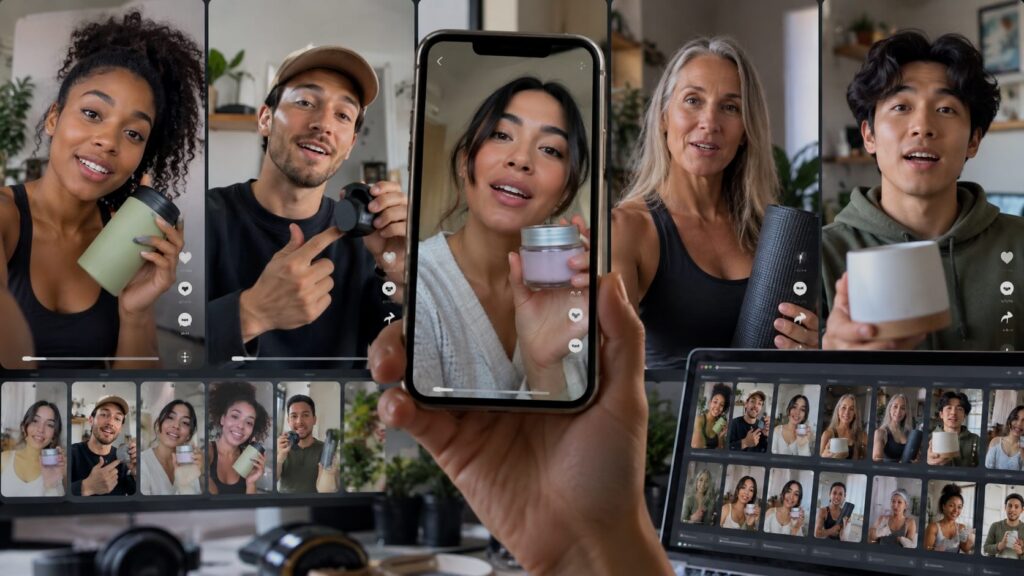

Quick answer: AI UGC video ads are short ads designed to look like user-generated content: a person talking to camera about a product, filmed “selfie-style”. The difference is that the presenter, voice or footage is created or heavily assisted by AI.
Why brands use them: you can test dozens of hooks, scripts and presenters quickly and cheaply.
The catch: they only work when the script is strong, the result looks authentic, and you don’t present an AI “customer” as a real one.
Introduction
Scroll any social feed and you’ll see them: someone talking straight to camera about a product they “can’t stop using”. User-generated content (UGC) has become one of the most popular ad formats online, because it feels like a recommendation rather than an ad. Now AI can produce that same look in hours instead of weeks: the presenter, the voice, even the “candid” phone-camera framing. (For the bigger picture, see our complete guide to AI video ads.)
At Gisteo, we’ve been making videos since 2011: more than 3,000 projects for brands like Intel, SAP and Harvard. We started with hand-crafted animation, and today we’re a hybrid studio, combining custom animation and live-action thinking with AI production. That puts us on both sides of this question every week. Clients ask us whether AI UGC ads are worth it, what they should cost, and when a tool is enough versus when they need a team.
This guide is our honest answer: what AI UGC ads are, what they cost, when they work, where the legal lines are, and what we’ve learned from experimenting with them ourselves.
What counts as an AI UGC ad?
“UGC-style” ads copy the look of real customer or creator videos: handheld framing, casual delivery and on-screen captions. AI versions come in three main forms:
| Type | How it’s made | Best for | Watch out for |
| AI avatar presenter | A digital presenter reads your script (see AI avatar videos) | Product explainers, app walkthroughs, FAQs | Stiff delivery if the script isn’t written for speech |
| AI voice + real footage | Real product shots with an AI voiceover and captions | E-commerce, demos, fast variations | Generic visuals without a clear hook |
| Real creator + AI editing | A human creator films; AI speeds up cutting, captions and versions | The most authentic results | Costs more and takes longer than pure AI |
What do AI UGC video ads cost?
There are two routes:
- DIY tools. Many AI avatar and ad tools run on monthly subscriptions. You get speed and volume, but you still have to write the scripts, choose the hooks, edit and check quality yourself.
- A done-for-you studio. At Gisteo, AI avatar videos start at $1,000, and AI cinematic videos at $3,500. (That $3,500 starting price is for longer cinematic films; shorter social media videos cost less, and we offer multi-video packages.) Scripting, direction, editing and quality control are included. See [AI video pricing](https://gisteo.com/ai-video-production-services/) or [all pricing](https://gisteo.com/explainer-video-pricing/).
The real cost isn’t the tool, it’s the time to make ads that actually perform. A tool gives you footage; it doesn’t give you a hook that stops the scroll.
When AI UGC ads work best
- Testing hooks and angles. Produce 5–10 openings for the same product and keep the winner. Here’s how studios deliver high-converting AI video ads with fast turnaround.
- Explaining a product simply. App features, how-tos and “3 reasons to try” formats.
- The same ad in several languages without reshooting.
- Always-on social campaigns that need fresh creative every week.
When a studio beats a DIY tool
| Situation | DIY AI tool | Studio |
| You need 1–2 quick test ads | ✓ | |
| You need a consistent brand look across many ads | ✓ | |
| The product is complex or regulated (finance, health) | ✓ | |
| Nobody on your team writes ad scripts | ✓ | |
| You need a mix of AI, animation and live footage | ✓ |
Proof: in our 62or70 case study. AI-produced campaign spots reached a 68% YouTube view rate, more than twice the typical average, and a 16% Facebook click-through rate. Human strategy and scripting did the heavy lifting; AI made production fast and affordable.
Meet NeanderChad: our (very) AI influencer experiment
To show what AI UGC can do, and where the line is, we created @Neanderchad]. He’s a Neanderthal’type with the habits of a modern alpha-male influencer: ice baths at sunrise, podcast appearances, tailored suits, and a leopard-print loincloth on the beach in Málaga.
Chad is just a fun experiment for our team, not a client campaign. But he shows the kinds of content you can now make with AI: lifestyle photos, talking-to-camera reels, podcast-style clips and fully edited short ads, all from a single character.
Every frame is AI-generated, and it looks exactly like the lifestyle-creator content brands pay for: the lighting, the “candid” angles and the captioned reels. That’s the point: the visuals are no longer the hard part.

The lessons for brands:
- AI can now produce any UGC look, from believable to absurd. Your advantage comes from the idea and the script.
- Personality beats polish. Chad’s captions do more work than his abs.
- Transparency builds trust. A clearly labeled AI character can be a brand asset; a hidden one is a liability.
The legal and trust line: don’t fake customers
AI UGC ads are fine when the presenter is clearly a spokesperson, not a “real customer”.
- The US Federal Trade Commission’s rule on fake reviews and testimonials, finalized in 2024, prohibits fake consumer testimonials, including ones generated by AI.
- Platforms such as Meta and TikTok also label or require disclosure of realistic AI-generated content.
The safe approach:
- Use AI presenters as brand spokespeople, not invented customers.
- Never attribute made-up results or quotes to “users”.
- Follow each platform’s AI-content disclosure rules.
How to make an AI UGC ad that converts
- Hook in the first 2 seconds: name the problem, don’t introduce yourself.
- One message per ad: one problem, one product, one call to action.
- Write for speech: short sentences that a real person would say.
- Captions on: most social video is watched without sound.
- Make variations, then measure: test hooks first, then offers, then endings.
The Bottom Line
AI hasn’t made good advertising easier. It has made production easier. Anyone can now generate a convincing UGC-style video; NeanderChad proves you can generate almost anything. What still separates ads that sell from ads that get scrolled past is the same as ever: a sharp hook, one clear message, a script written for real people, and the discipline to test and improve.
That’s where a studio earns its place. At Gisteo, we pair AI’s speed and low cost with human strategy, scriptwriting, direction and quality control. It’s the approach behind the 68% YouTube view rate our AI ads achieved for 62or70. And because we also make custom animation, we’ll tell you honestly when AI UGC is the right tool and when it isn’t.
Ready to test AI UGC ads for your brand?
- See our AI video productions page.
- Book a free consultation to discuss our AI ad services.
FAQs
What does UGC stand for in advertising?
User-generated content: videos and photos that look like they were made by customers or creators rather than a brand.
Are AI UGC ads effective?
They can be, especially for testing many versions quickly. Results depend on the script and the hook more than the tool. The 62or70 campaign reached a 68% YouTube view rate.
How much does an AI UGC ad cost?
DIY tools run on monthly subscriptions. Done-for-you AI avatar videos from Gisteo start at $1,000, with scripting and editing included.
Is it legal to use AI people in ads?
Yes, as spokespeople. It’s not OK to present an AI person as a real customer giving a testimonial: the FTC’s 2024 rule on fake reviews and testimonials covers AI-generated ones.
Can a brand create its own AI influencer?
Yes, as long as it’s clearly labeled as AI. See our satirical example, [NeanderChad](https://www.instagram.com/neanderchad/), whose profile is openly marked “AI-generated”.
Should I use AI UGC or hire real creators?
Use AI to test angles fast and cheaply. Use real creators, or a hybrid, when authenticity is the main selling point.