
Introduction
A year ago, “AI video” meant awkward avatars and footage that screamed “made by robots.” Today, AI videographers are producing cinematic content that’s increasingly difficult to distinguish from traditional production—at a fraction of the time and cost.
This shift isn’t theoretical. The global AI in media and entertainment market hit $10.87 billion in 2021 and is projected to grow at 26.9% annually through 2030. But the real story isn’t in market projections—it’s in how these tools are changing daily workflows for filmmakers, marketers, and businesses producing video content.
Here’s what’s actually happening on the ground, and what it means for anyone creating video in 2026.
Quick Answer: AI videographers use artificial intelligence to automate and enhance video production—from generating footage and editing clips to tracking subjects and analyzing content in real time. These tools are reducing production timelines by up to 80% while enabling capabilities like autonomous camera tracking, intelligent editing, and cinematic AI-generated visuals. The technology works best when combined with human creative direction, which is why agencies like Gisteo pair AI efficiency with professional storytelling.
What AI Videographers Actually Do
The term “AI videographer” covers a range of capabilities that would have seemed impossible just a few years ago.
Generative video creation. Text-to-video tools like Runway, Sora, and Veo can now generate original footage from written prompts. Describe a scene—”a woman walking through a rain-soaked Tokyo street at night”—and the AI produces footage that looks like it was shot on location.
Intelligent editing. AI editing tools analyze raw footage, identify the strongest moments, suggest cuts, and even sync content to music automatically. What used to take days of manual review now happens in minutes.
Autonomous camera systems. AI-powered cameras can track moving subjects without a human operator, adjusting focus, exposure, and framing in real time. Sports broadcasts, live events, and documentary filmmakers are already using these systems.
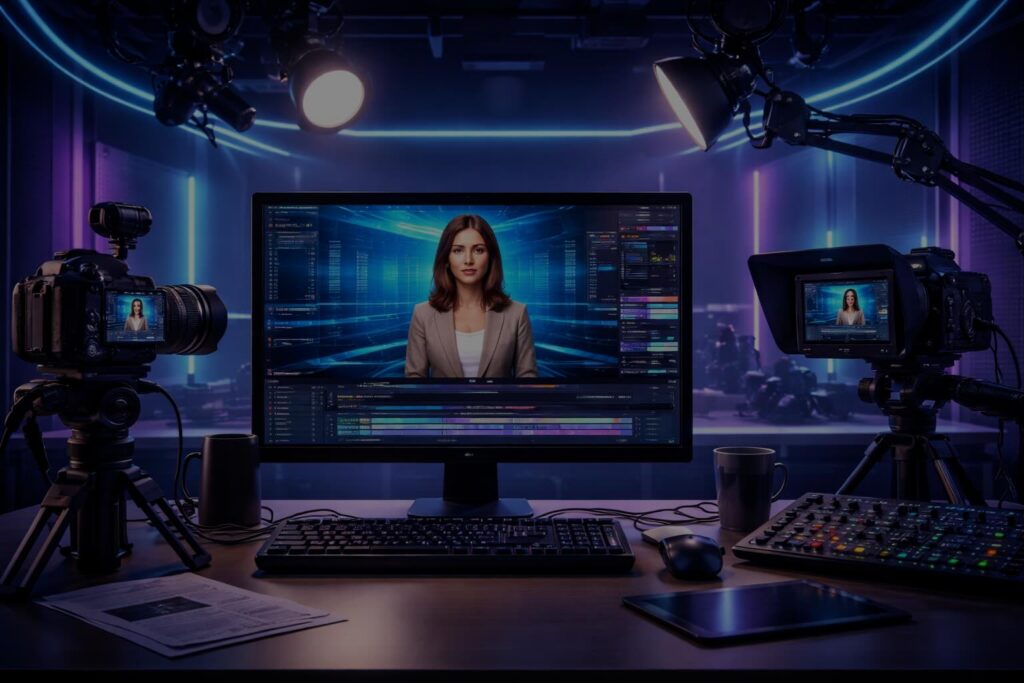
AI avatars and presenters. Digital humans can deliver scripts in multiple languages with natural lip-sync and expressions. Training videos, explainers, and corporate communications increasingly use AI presenters instead of hiring on-camera talent.
At Gisteo, we use these tools daily—combining generative AI for cinematic visuals with AI avatars for presenter-style content. The key is knowing which tool fits which job, and that’s where human expertise still matters.
The Real Impact: Speed and Accessibility
The numbers are striking. AI video editing can reduce post-production time by up to 80%. But the bigger story is accessibility: capabilities that once required six-figure budgets and full production crews are now available to small businesses, independent creators, and marketing teams.
Consider what’s changed. A marketing agency that used to spend weeks piecing together client projects can now input raw clips and let AI do the initial assembly—selecting shots, suggesting music, and creating rough cuts in hours. A documentary filmmaker drowning in footage can use AI to surface the most compelling moments rather than watching everything manually.
This isn’t about replacing human creativity. It’s about removing the bottlenecks that kept video production expensive and time-consuming. When AI handles the tedious work, creators can focus on what actually matters: storytelling.
Cinematic AI: Beyond Basic Automation
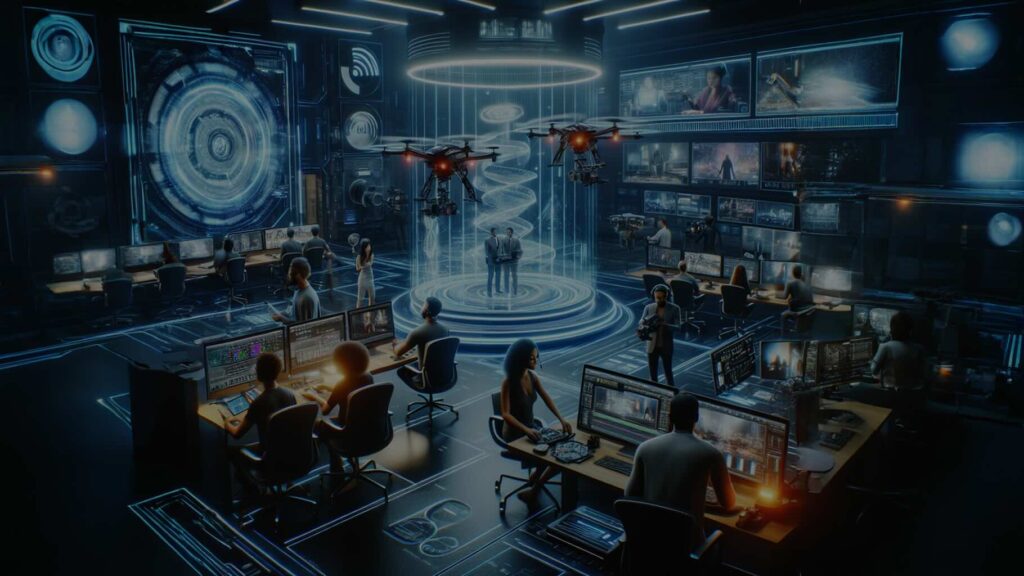
The latest generation of AI video tools has moved well beyond simple automation. We’re now seeing genuinely cinematic output—footage with depth, atmosphere, and visual sophistication that holds up alongside traditional production.
At Gisteo, our cinematic AI productions use tools like Veo 3, Runway, Sora, and MidJourney to create movie-style visuals: AI-generated characters, sweeping camera movements, richly rendered environments. A recent project—a 60-second commercial created entirely with AI—took six hours from concept to completion, with zero human actors, cameras, or locations. The result was indistinguishable from a traditionally produced spot.
This capability opens creative possibilities that were previously cost-prohibitive. Need a scene set in 1920s Paris? A futuristic cityscape? A product floating through an abstract environment? AI can generate these visuals without the expense of sets, travel, or CGI studios.
Intelligent Camera Systems
AI isn’t just generating footage—it’s changing how we capture it. Intelligent camera systems equipped with computer vision can now track subjects autonomously, making split-second adjustments to focus, exposure, and framing.
Picture a documentary crew filming urban wildlife. Instead of manually adjusting the camera as animals move unpredictably, they deploy an AI-powered system that tracks movement automatically. The crew focuses on positioning and storytelling while the technology handles the technical execution.
Live event production has embraced these systems enthusiastically. A wedding videographer can set up cameras that automatically adjust for changing lighting conditions—candles flickering, clouds rolling in—without manual intervention. Sports broadcasts use AI tracking to follow action that would be impossible for human operators to capture consistently.
Autonomous drone videography takes this further, capturing aerial shots that would have required expensive helicopter rentals and specialized pilots just a few years ago.
AI-Powered Editing: Precision Meets Efficiency
If you’ve ever faced hours of raw footage wondering where to start, AI editing tools feel like a revelation. These systems analyze your clips, identify key moments, and suggest edits based on pacing, emotion, and viewer engagement patterns.
The technology goes beyond simple automation. Modern AI editing tools learn from user preferences over time. If you favor quick cuts and dramatic transitions, the software adapts its suggestions to match your style. It’s like having an assistant editor who understands your creative vision.
Real-time analysis during filming adds another dimension. Instead of waiting until post-production to discover a critical shot was out of focus, AI can flag issues immediately—giving you the chance to reshoot on the spot.
Predictive analytics take this further still. By analyzing engagement metrics from previous videos, AI tools can suggest which shots are likely to resonate with audiences, helping creators make data-informed decisions during the editing process.
The Human Element: Why AI Isn’t Enough on Its Own
Here’s what the AI hype often misses: the technology is only as good as the creative direction guiding it.
AI tools can generate impressive footage, but they can’t understand your brand. They can suggest edits, but they don’t know your audience’s emotional triggers. They can produce technically competent content, but they struggle with the narrative intuition that makes video memorable.
This is why the most effective AI video production combines technological capability with human expertise. At Gisteo, every AI project starts with human-led strategy and scriptwriting. We use AI to accelerate production—handling visuals, voiceover, and editing—while ensuring the output aligns with brand voice and marketing objectives.
The agencies and creators getting the best results aren’t the ones with the most advanced AI tools. They’re the ones who understand when to let AI lead and when human judgment needs to take over.
Challenges and Limitations
AI videography isn’t without challenges. Understanding the limitations helps set realistic expectations.
Consistency across shots. AI-generated footage can struggle to maintain visual consistency between scenes, especially with complex subjects. Characters may shift appearance slightly; environments may not quite match from one shot to the next.
The uncanny valley. AI avatars have improved dramatically, but some viewers still detect something “off” about digital humans. For certain applications—particularly those requiring deep emotional connection—this can be a limitation.
Prompt interpretation. AI tools sometimes misinterpret creative direction, producing results that miss the mark. Effective AI video production requires iteration and refinement—it’s rarely one-and-done.
Ethical considerations. Questions around bias in training data, intellectual property, and the authenticity of AI-generated content are still being worked out. Responsible use requires awareness of these issues.
These limitations are real, but they’re also evolving rapidly. What was impossible six months ago is routine today. The key is working with partners who understand both the capabilities and the constraints.
What’s Coming Next
The pace of advancement in AI video shows no signs of slowing. Several trends are worth watching.
Real-time generation. We’re moving toward AI that can generate video in real time, opening possibilities for live, interactive content that adapts on the fly.
Improved consistency. Tools for maintaining character and environment consistency across longer videos are advancing quickly, making AI viable for more complex narrative projects.
Deeper personalization. AI video that adapts to individual viewers—changing messaging, visuals, or even characters based on who’s watching—is moving from concept to reality.
Integration with other AI tools. Video generation is increasingly connecting with AI copywriting, voice synthesis, and analytics to create end-to-end content workflows.
For businesses and creators, the message is clear: AI video capabilities are expanding faster than most organizations can track. Partnering with agencies that stay current on these developments—and know how to apply them practically—is becoming a competitive advantage.
The Bottom Line for Video Production
AI videographers aren’t replacing human filmmakers—they’re amplifying what’s possible. The technology handles the time-consuming technical work, freeing creators to focus on strategy, storytelling, and the creative decisions that actually move audiences.
For businesses, this shift means video content is more accessible than ever. Projects that would have required weeks and five-figure budgets can now be completed in days at a fraction of the cost. The barrier to professional video has dropped dramatically.
The winners in this new landscape will be those who embrace AI as a tool while maintaining the human oversight that ensures quality, brand consistency, and emotional resonance. Speed matters, but only if the output actually works.
At Gisteo, we’ve built our AI video production services around this principle. We combine the efficiency of AI—generative visuals, avatar presenters, automated workflows—with the strategic thinking and creative direction that comes from 14 years of explainer video production. The result is professional video content delivered in days, not weeks, that sounds like your brand and achieves your marketing objectives.
Ready to see what AI-powered video production can do for your business? Explore Gisteo’s AI video production services or schedule a consultation to discuss your next project.