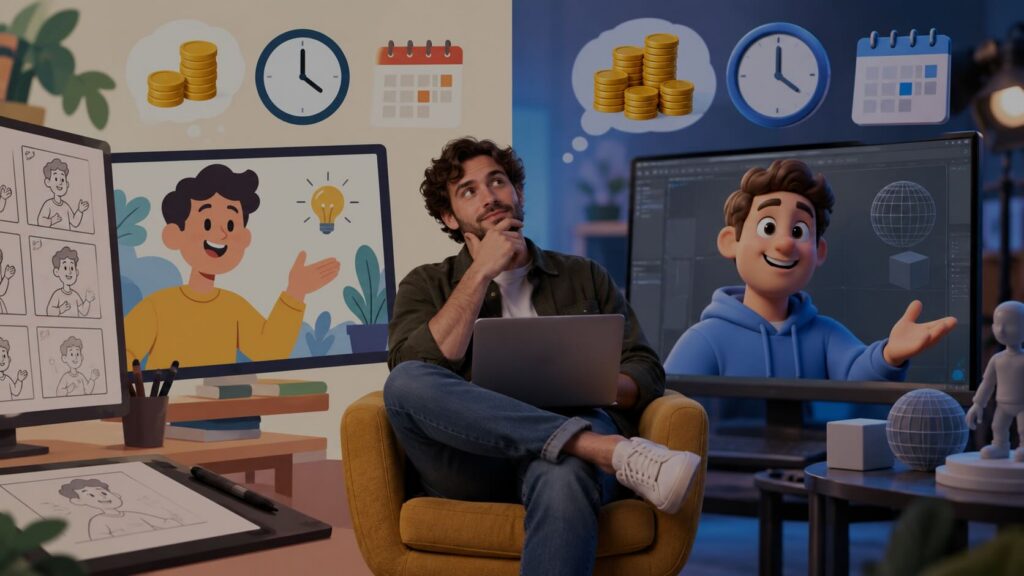

| IS AI VIDEO GOOD ENOUGH FOR PROFESSIONAL USE?
Yes — for specific jobs. In 2026, AI video production is professional-grade for product explainers, presenter-led content, training, social ads, and brand vignettes, and AI-produced work now runs in paid placements on major platforms. It is not yet reliable for precise brand-character consistency, complex multi-character narrative animation, or projects requiring specific real people. The quality ceiling is no longer the tools — it’s the script, direction, and judgment applied to them. |
Introduction
Is AI video good enough for professional use? Three years ago the answer was obviously no, and the internet’s favorite proof was a nightmarish AI clip of Will Smith eating spaghetti. In 2026, the honest answer is yes — for specific jobs, under real creative direction — and pretending otherwise mostly signals that someone hasn’t looked recently.
Gisteo is in an unusual position to answer this question, because we don’t have a side to defend. We’ve produced explainer videos since 2011 — more than 3,000 projects for clients including Intel, Harvard, Oracle, and Bills.com — and we now produce both traditional custom animation and AI video, choosing per project. When AI is the wrong tool, we say so and produce the traditional route. That means the answer below isn’t a platform selling you software or a legacy studio defending its process. It’s what we actually see in production, every week.
The short version: the question has changed. “Is AI video good enough?” used to be a question about the tools. In 2026 it’s a question about the people using them.
What Changed: From Spaghetti to Paid Placements
The distance traveled is easy to underestimate if you checked out in 2023. That year’s viral benchmark — the Will Smith spaghetti clip — showed a technology that couldn’t hold a face together for two seconds. When we re-ran the same test with current tools in 2026, the generational leap was obvious: coherent motion, consistent lighting, plausible physics, photoreal texture. The progress is real, and by every indication we’re still early in the curve.
But viral benchmarks aren’t the professional test. The professional test is whether the output survives commercial scrutiny — a client’s brand review, a media buyer’s quality bar, a paying audience. On that test, here’s concrete evidence from our own production: in July 2025, I produced a complete parody commercial (concept, script, scene-by-scene AI production, final edit) in a single six-hour Sunday; it generated hundreds of many thousands of views in a very short amount of time. Here’s the silly video if you can to indulge 🙂
Since then, Gisteo’s AI work has included productions for Cloudflare and AI-produced ads that have run on Netflix. Ads on a major streaming platform pass through exactly the kind of quality gates that “professional use” implies. That bar has been cleared — not hypothetically, in shipped work.
What has not changed: none of those projects were prompt-and-pray. Each one was scripted by a human, directed scene by scene, and quality-checked against the same standards as traditional work. The tools got professional. The workflow that makes them professional is still human.
Where AI Video Is Professional-Grade Today
Based on what’s actually shipping — ours and the broader market’s — AI production is a fully professional choice in 2026 for:
- Explainers and product video. Product explainers, feature overviews, and landing page videos, where message clarity drives the result and AI execution is indistinguishable from mid-to-high-tier animation for most viewers.
- Presenter-led content. AI avatar presenters — built from real human actors — deliver training, onboarding, FAQ, and corporate messaging convincingly, with multilingual versions from a single production. For internal and educational use, this category is not just “good enough”; it’s often better than what most companies previously shipped.
- Brand vignettes and social ads. Short cinematic vignettes for brand storytelling, launches, and social — sweeping camera work and rich environments that previously required a film crew. This is where the 2024–2026 model generation changed the economics most dramatically.
- Versioning and volume. Cutdowns, aspect ratios, silent versions, and language variants at a speed and cost traditional pipelines can’t approach.
The pattern across all four: these are jobs where the message architecture matters more than frame-perfect visual control, and where AI’s speed compounds into more assets, more testing, and more channels for the same budget.
Where AI Video Still Falls Short
An honest answer requires the other half. In 2026, AI production remains the wrong choice for:
- Precise brand-character consistency. Keeping a proprietary mascot or brand character pixel-consistent across scenes and campaigns is still unreliable. If your brand IS a character, traditional animation still wins.
- Complex multi-character narrative. Long-form animation with several interacting characters, tight choreography, and narrative continuity remains beyond dependable AI production. The failure modes are subtle and expensive to fix late.
- Real people, real places. Specific real people — founders, spokespeople, customers — in specific real places still means cameras. (Likeness generation of real people also raises consent issues no professional brand should touch casually.)
- Exacting visual control. Frame-exact art direction — a precise visual language a designer can spec and an animator can hit — is still a hands-on-keyframes discipline. AI gets you a look; it doesn’t yet reliably hit YOUR look.
None of these are permanent walls; all of them have moved in twenty-four months. But a professional recommendation is about what ships reliably today, and today these jobs route to traditional production. This is why we kept our custom animation offering rather than going AI-only: the honest answer to “is AI good enough?” is sometimes “not for this project.”
The Real Quality Ceiling: Judgment, Not Tools
Here’s the part most coverage of this question misses. Now that professional-grade output is achievable, the differentiator has moved. When everyone has access to the same models, the tools stop being the advantage — and the scarce input becomes discernment: knowing what a good frame looks like, what a persuasive script sounds like, which of forty generated options serves the message, and when to throw all forty away.
This is visible in the market. The flood of AI video content is real, and most of it is professionally useless — not because the pixels are bad, but because the message is generic, the pacing is off, and nobody with taste made the calls. Meanwhile, the same tools in experienced hands produce work that runs on major ad platforms. Identical technology, opposite outcomes. The variable is judgment.
The practical implication for anyone evaluating this question: “is AI video good enough for professional use” is really two questions. Are the tools capable? Yes. Will YOUR output be professional? That depends entirely on the script, direction, and quality control wrapped around the tools — which is the argument for using a production service with human creative direction rather than prompting alone, at least for anything customer-facing. Our guide to choosing an AI video production service covers how to evaluate that layer.
A Job-by-Job Verdict
| Use case | AI in 2026 | Notes |
| Product / service explainers | Professional-grade | Script quality is the deciding variable |
| Training, onboarding, internal comms | Professional-grade | Avatar formats often beat prior in-house output |
| Social ads and brand vignettes | Professional-grade | AI-produced ads now run on major platforms |
| Multilingual versions | Professional-grade | One production, many languages |
| Brand mascots / proprietary characters | Not yet | Traditional animation remains the reliable route |
| Multi-character narrative animation | Not yet | Continuity failures are subtle and costly |
| Content requiring real people on camera | No | Filming — and consent — still required |
What This Means for the Biggest Winners: SMBs
One more consequence worth naming. The businesses gaining most from this shift aren’t the big brands — they always had video budgets. It’s the small and mid-sized companies that were priced out of professional video entirely when a credible explainer started at five figures. At AI-era price points — professionally scripted and directed AI video starting around $1,000 — the format that used to be a luxury line item is now available to nearly any serious business. That’s not a quality compromise story; for these companies it’s a first-access story.
Gisteo’s tiers reflect that range deliberately: AI Avatar from around $1,000, AI Cinematic from around $3,500, traditional custom animation from $3,500 for the jobs AI can’t do yet, and an Unlimited Yearly plan for teams producing continuously. The format follows the project — which is exactly how a professional decision about AI video should work. Teams that want the numbers first can review explainer video pricing.
FAQs: AI Video for Professional Use
Is AI video good enough for professional use in 2026?
Yes, for specific jobs: product explainers, presenter-led training and onboarding, brand vignettes, social ads, and multilingual versioning are all professional-grade with proper creative direction — AI-produced ads now run in paid placements on major platforms. It’s not yet reliable for consistent brand characters, complex multi-character narrative animation, or content requiring specific real people.
Can AI-generated video be used in paid advertising?
Yes. Professionally directed AI video is already running as paid advertising on major platforms, including streaming services — Gisteo’s AI productions include ads that have appeared on Netflix. Ad placements impose real quality gates, so this is a meaningful benchmark: the format clears professional review when the production process is professional.
Will viewers be able to tell a video was made with AI?
For well-directed explainers, avatar presenters, and cinematic vignettes — usually not, and increasingly it doesn’t matter: viewers judge whether the video is clear, credible, and worth their attention. Poorly directed AI video is recognizable, but what viewers are detecting is the absence of craft, not the presence of AI.
What are the biggest limitations of AI video in 2026?
Precise brand-character consistency across scenes, complex multi-character narrative animation, frame-exact art direction, and any content requiring specific real people or places. These jobs still route to traditional animation or live-action production — which is why providers offering both can make the honest per-project call.
Is AI video cheaper than traditional video production?
Substantially. Professionally produced AI Avatar videos start around $1,000 and AI Cinematic around $3,500, versus roughly $3,000–$8,000+ for traditional custom animation and far more for filmed production. The savings come from execution speed; the script and direction that make the video work are the same human work in either route.
Should I use an AI video platform or a production service?
For internal content at volume, a self-service platform can be the right infrastructure. For anything customer-facing — marketing, sales, brand content — a production service with human scripting and direction produces materially better results, because the tools’ quality ceiling is now set by the judgment applied to them, not the technology itself.
Is AI video quality still improving?
Rapidly. The gap between 2023’s viral failure clips and 2026’s output is generational, and the trajectory suggests we’re still early. Limitations listed today — character consistency, narrative complexity — are active research targets. Professional buyers should make the AI-vs-traditional call per project and expect the answer to keep shifting toward AI.
Does Gisteo recommend AI or traditional production?
Per project — that’s the point. Gisteo has produced 3,000+ videos since 2011 and now runs both routes: AI Avatar and AI Cinematic where they’re the professional choice, traditional custom animation where AI isn’t there yet. Request a free consultation and you’ll get a straight recommendation for your specific project, whichever route that turns out to be.
Conclusion: The Question Has Changed
Is AI video good enough for professional use? In 2026, for a wide and growing set of commercial jobs, yes — demonstrably, in shipped work that runs in paid placements. For a shrinking set of jobs, not yet. The professional move isn’t picking a side; it’s knowing which list your project is on.
And the deeper answer is that the question itself has moved. The tools cleared the professional bar. What separates professional output from the flood of generic AI video now is the same thing that separated good video from bad before any of this existed: a clear message, a sharp script, and someone with taste making the calls.
Gisteo has been making those calls since 2011 — 3,000+ projects, both routes, chosen honestly per project. To find out which route yours needs, request a free consultation.